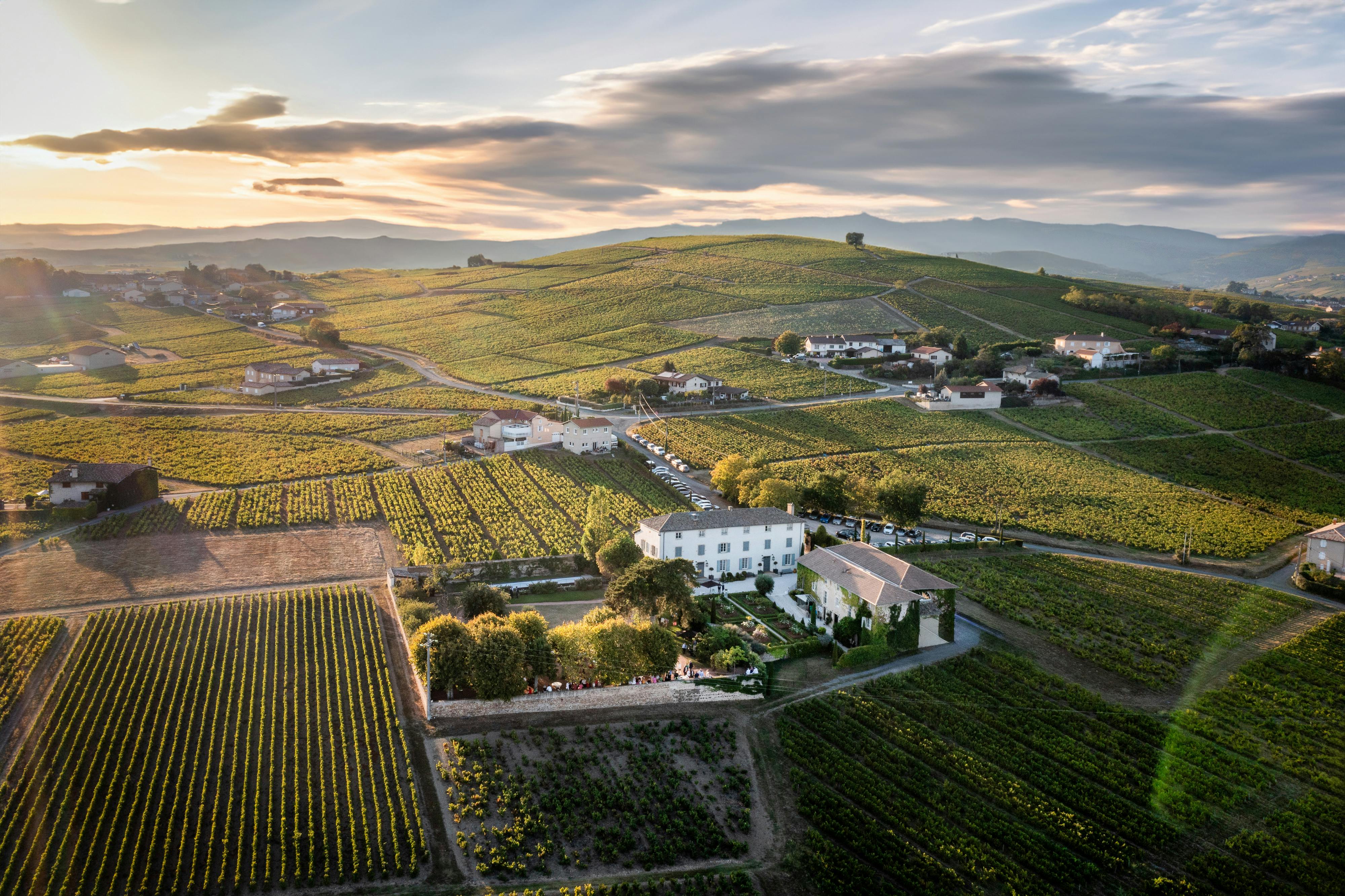
Georges Duboeuf made Beaujolais Nouveau into the world's most elaborate wine marketing event — annual races to Paris, helicopter deliveries to London, and a third Thursday in November that turned light red wine into a global calendar fixture. It worked spectacularly. It also obscured, for roughly four decades, what his cellars were doing in parallel: sourcing and bottling single-domaine wines from the ten Beaujolais Crus that were never about the rush, always about what Gamay can do when it's allowed to develop.
Gamay on granite soils behaves like a completely different grape from the Gamay that produces Nouveau. Moulin-à-Vent, built on manganese-rich decomposed granite, produces wines with tannin structure and an ageing curve that rivals the lower Côte d'Or — bottles from strong vintages open up over years, not weeks. Morgon, on blue schist and stone, runs darker and more mineral, with fruit that starts at cherry and moves towards iron with age.
Georges Duboeuf
Duboeuf built his Cru program through long-term single-domaine partnerships rather than blended purchasing — a choice that separated his serious bottles from the standard négociant model before that model had a name. Fleurie La Madone, sourced from a single estate, has earned 94 points from Wine Advocate. Morgon Jean Ernest Descombes, bottled in partnership with one of the Cru's benchmark producers, draws 93 from the same critic — numbers that belong to a different conversation from the Nouveau launch parties.
Duboeuf produces more than 2.5 million cases annually — a figure that made him easy to dismiss as a volume house. His Cru portfolio is where that scale funded something more precise: wines from named places, from named growers, at prices that sit well below their Burgundian equivalents. Gamay on granite is not a footnote to Pinot Noir, and Duboeuf's track record of single-domaine Cru wines is the clearest argument for taking it seriously.