Germany's Prädikat system tells you what sugar the grapes had when they were picked, not what the wine tastes like when you open it. That is the central confusion, and it traps almost every reader who has ever seen 'Kabinett' on a label and assumed light, or 'Spätlese' and assumed sweet. Both can be dry. Both can be off-dry. Both can be sweet. Prädikat itself doesn't say.
What Prädikat measures is Oechsle, a hydrometer reading taken at harvest. Six rungs climb in order — Kabinett, Spätlese, Auslese, Beerenauslese, Eiswein, Trockenbeerenauslese — and each rung requires a higher concentration of must sugar than the last. Kabinett starts around 67 degrees Oechsle. By Trockenbeerenauslese the grapes are essentially raisins. None of those rungs says anything about how much sugar ends up in the finished wine.
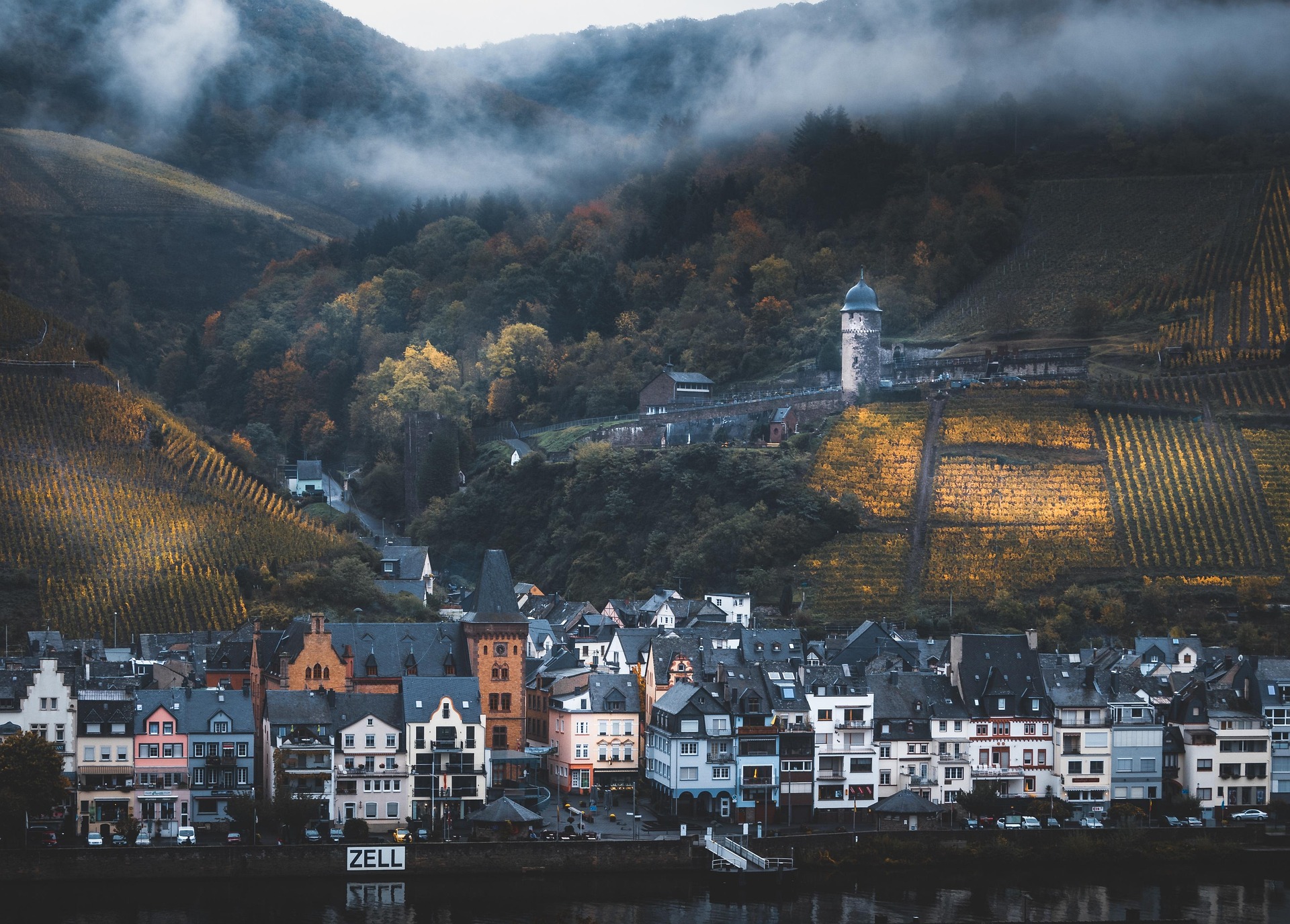
Mosel
That is the cellar's decision. Winemaker chooses how far to ferment — to dryness, to off-dry, to lush — and the only label clue is the word 'Trocken' (dry) or 'Halbtrocken' (half-dry), tacked onto the Prädikat. Spätlese Trocken from the Rheingau runs bone-dry at around 13% alcohol; a Spätlese without that modifier might be balanced around 50 grams of residual sugar instead.
Dry styles now dominate serious German Riesling. In 2002 the VDP — Germany's elite producers' association — created Grosses Gewächs, capped at 9 grams of residual sugar per litre, to anchor the dry category at grand-cru level. Mosel still produces large volumes of off-dry and sweet Kabinett, but the centre of gravity has moved firmly toward trocken.
Practical read on a German label is straightforward. Find the Prädikat — that tells you how concentrated the raw material is. Find 'Trocken' (or its absence) — that tells you the cellar's intent. Treat them as two separate axes, never one. System is precise; the precision is just not where most people think it is.