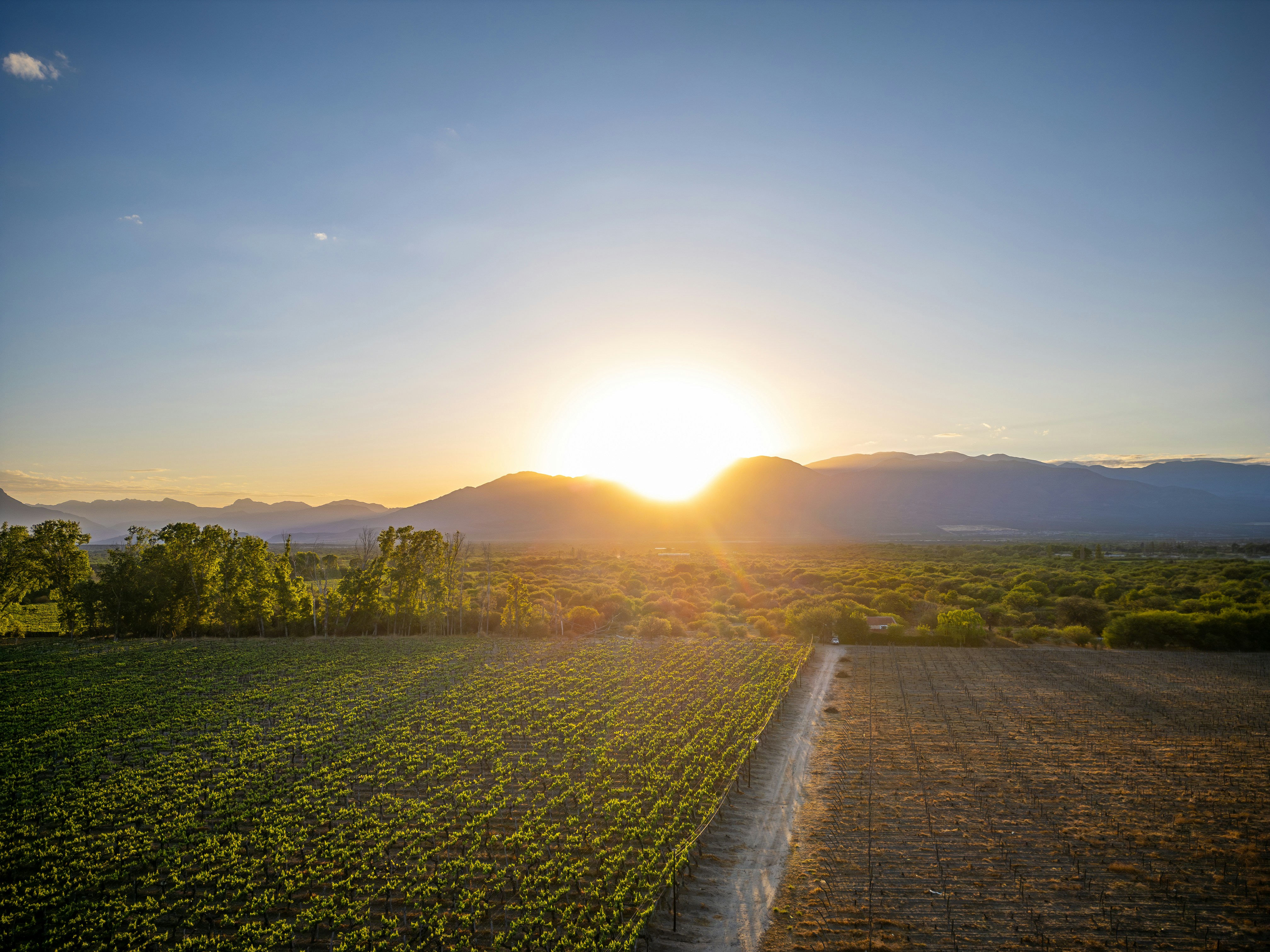
Argentine Malbec's reputation rests on the grape variety — but the mechanism behind what makes it distinctive is altitude. Plant the same vine at 1,200 metres in Mendoza's Uco Valley and at sea level in France's Cahors, and the wine produced tastes fundamentally different. The altitude is doing more of the work than the variety.
At high elevation, UV-B radiation intensity increases significantly — roughly double the strength at 1,200 metres compared to sea level. Malbec responds to this stress by producing thicker skins, the plant's defensive mechanism against solar damage. Those thicker skins concentrate the anthocyanins responsible for Malbec's characteristically deep colour, and the polyphenols that build tannin structure. The same variety grown below 500 metres produces a thinner-skinned berry with lighter colour and softer tannin — a structurally different wine, not simply a weaker version of the same one.
Altitude also imposes cold nights. In the Andean foothills, the temperature differential between midday heat and evening cool can exceed 20°C during the growing season. This thermal swing slows sugar accumulation in the berry, extending the window for flavour development before the grapes reach harvest-level ripeness. Acidity is preserved in this environment because the vine isn't forced to sacrifice it for rapid ripening — which is why high-altitude Argentine Malbec carries both fruit richness and the structural freshness that allows it to develop in bottle.
Mendoza
Within Mendoza — home to 3,134 wineries across the region — the altitude gradient between zones is measurable in the glass. Luján de Cuyo, sitting around 900 metres, produces Malbec with plush fruit and integrated tannins that drink relatively young. The Uco Valley, at 1,000–1,500 metres, produces wines with sharper acidity and more structural grip that need time but develop more complexity. Producers working across both zones have mapped this difference systematically through single-vineyard bottlings that use the same variety to argue for the altitude difference.
For a wine buyer, the practical instruction follows from the mechanism: when a label specifies a Uco Valley sub-zone or an altitude, the wine will need more time in the cellar and offer more structural complexity. Standard Mendoza Malbec at lower elevations drinks earlier and works across a wider range of occasions. The grape is always Malbec; what varies is the altitude that shaped it — and that variation is the most important thing on the label.