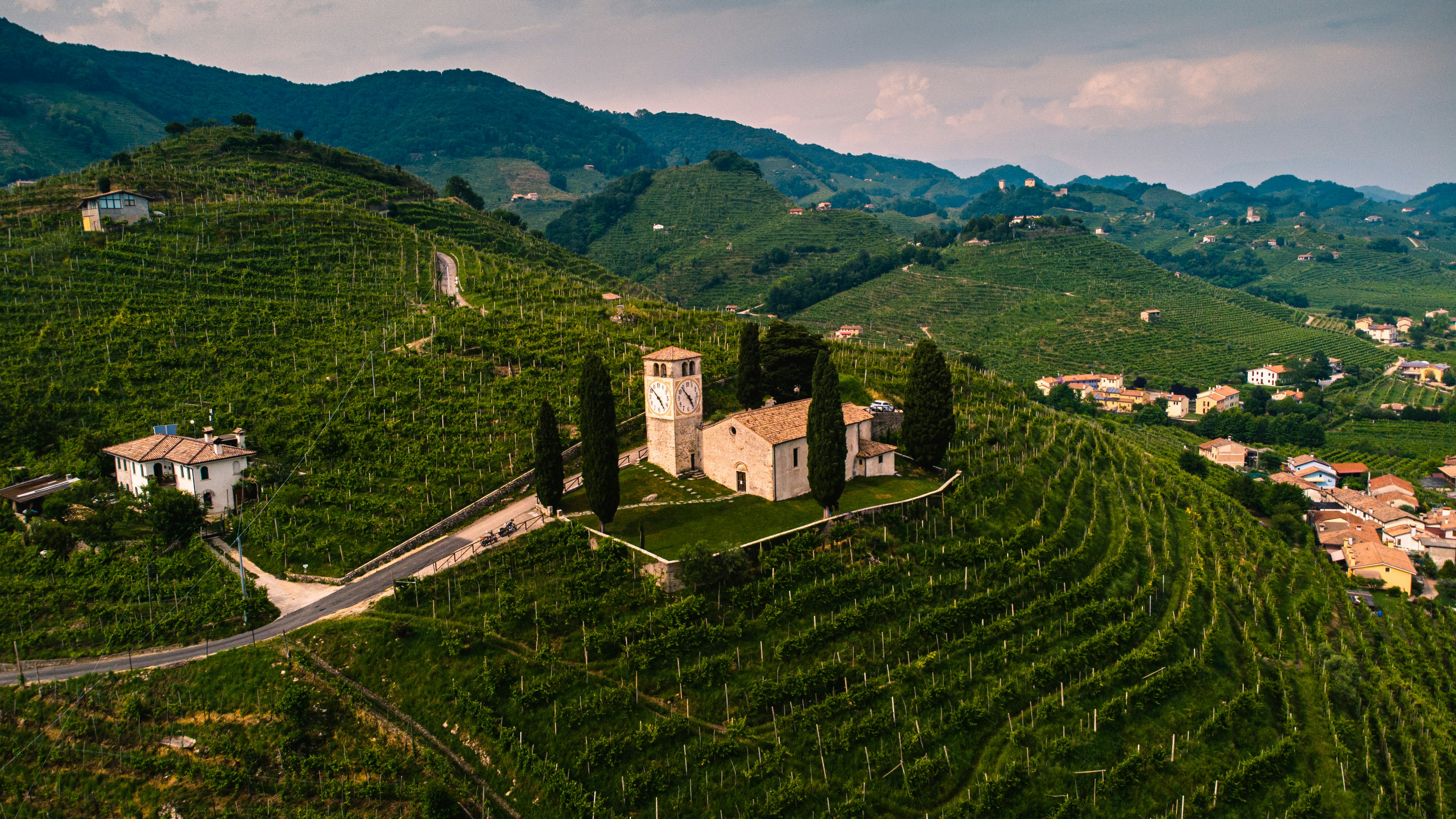
Veneto is Italy's most internally divided wine region. Prosecco and Amarone share a geography but almost nothing else — not the grape, not the method, not the timescale, not the occasion. That contradiction is not a flaw in the region's identity; it is the identity.
Glera is the engine of northern Veneto, producing 5,493 wines and accounting for more bottles than any other grape in the region. The variety's high natural acidity and resistance to oxidation make it suited to the tank-fermentation method that preserves freshness in Prosecco. Valdobbiadene and Conegliano anchor the DOCG heartland — hillside zones where steep terrain and volcanic soils add aromatic lift and mineral edge that the broader Prosecco DOC cannot guarantee. The style designed here — effervescent, light, structured for an aperitivo — became one of the fastest-growing wine categories globally because it asks almost nothing of the drinker and delivers pleasure immediately.
Veneto
Move southwest to Valpolicella — 453 wineries concentrated in the hills west of Verona — and the entire frame inverts. Red wines account for 11,110 of Veneto's bottles, edging sparkling by a margin that obscures how different the logic is. Corvina, the backbone of Valpolicella, is picked for its thick skins rather than its aromatics, then laid on bamboo racks in open lofts to dehydrate for several months. This is appassimento: the controlled drying that transforms a mid-weight red into the raw material for Amarone della Valpolicella. The wine that emerges is dense, tannic, and built for a cellar — not for immediate drinking.
Between these two poles sits Soave, Veneto's most overlooked appellation. Garganega, a late-ripening white with natural waxy texture, accounts for 1,638 wines in the region and produces, in Soave Classico, a wine capable of aging a decade on volcanic basalt hillsides. The Classico designation marks the line between the original hilltop zone and the flatlands planted for volume in the 1970s. Those expanded vineyards set expectations that the best producers in the Classico zone are still working to correct.
Choosing a wine from Veneto means choosing which wine culture to enter. The region works best understood as three distinct appellations sharing a border: the effervescent hills above Valdobbiadene, the drying lofts of Valpolicella, and the volcanic slopes of Soave Classico. Each addresses a different occasion and a different understanding of what wine is for.