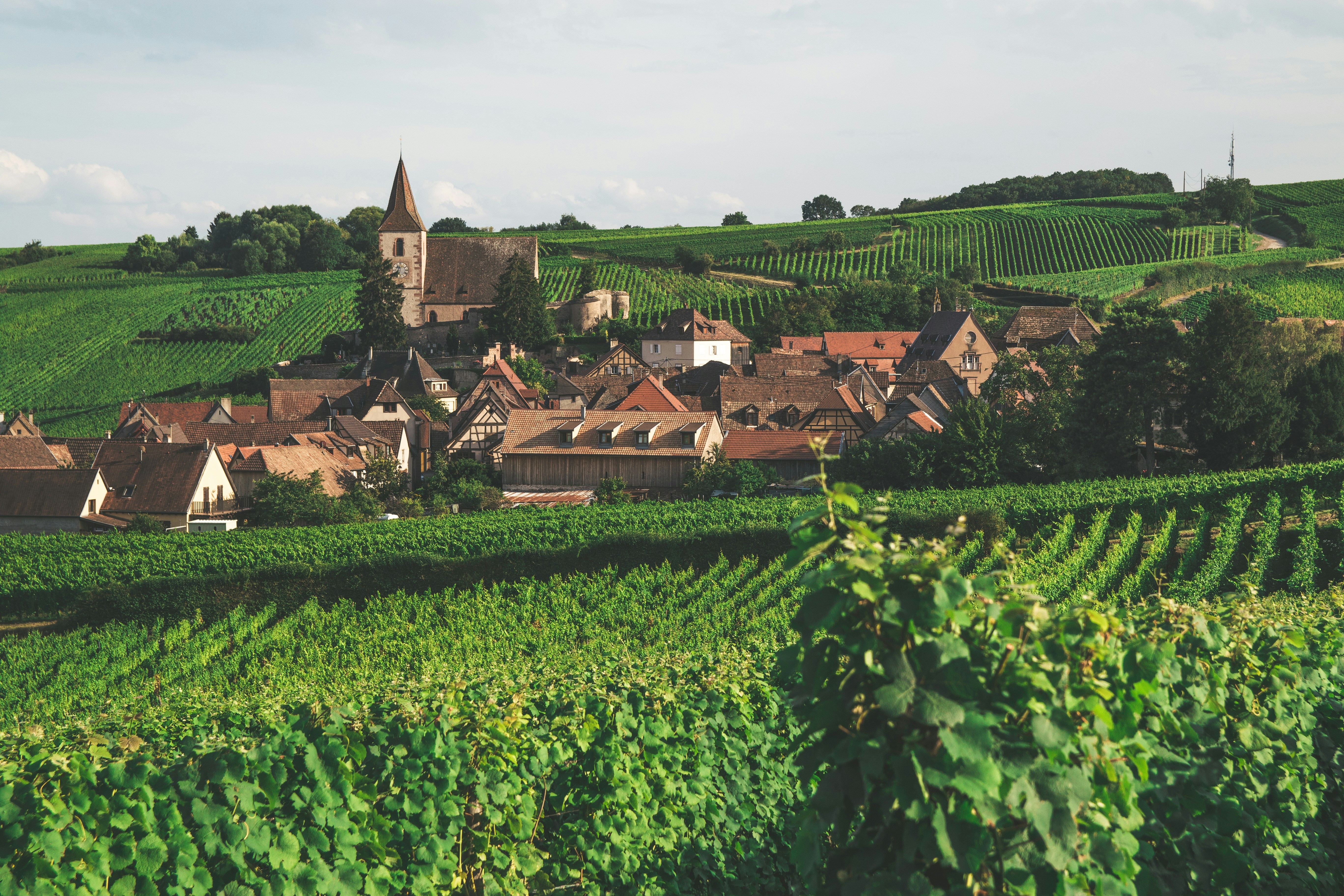
The Alsace Wine Route (Route des Vins d'Alsace) was France's first formally designated tourist wine route, established in 1953. It runs 170 km along the eastern edge of the Vosges mountains, from Marlenheim in the north to Thann in the south, weaving through more than a hundred named villages. The route is deliberately laid out: it follows the strip of land where the Vosges' rain shadow makes Alsace one of France's driest and sunniest wine regions, and where Alsace's 51 Grand Cru sites sit. We covered the Alsace style in detail in our Mosel vs Alsace Riesling piece; here's the practical touring side.
The route, north to south
The Wine Route is signposted (look for the distinctive Route des Vins signs) and follows mostly the D422 and D35 roads. You don't need to drive the entire 170 km. Most travelers pick a 30-50 km section as a multi-day base. The villages cluster in two main groups:
Northern section (Strasbourg-anchored): Marlenheim, Wangen, Westhoffen, Molsheim. Closer to Strasbourg, less famous than the central section, more workmanlike.
Central section (Colmar-anchored, the canonical part): Bergheim, Ribeauvillé, Hunawihr, Riquewihr, Kaysersberg, Turckheim. This is the section every photo of "the Alsace Wine Route" shows: half-timbered medieval houses, geranium-filled balconies, vineyards starting at the village edge, the Vosges rising directly behind. Riquewihr and Eguisheim are routinely listed among "France's most beautiful villages" and are tourist destinations in their own right.
Southern section (Mulhouse-anchored): Guebwiller, Thann. Less visited than the centre, but the southernmost Grand Cru sites (Rangen de Thann, Kitterlé, Kessler) are some of the most distinctive in the region.
For first-time visitors, the central section is the canonical experience: base in Colmar (a city in itself worth visiting), drive 20-40 km of Wine Route per day, do not try to cover the full 170 km.
What to drink: the prestige tier
Domaine Zind Humbrecht, Turckheim
Domaine Zind Humbrecht, FEM 91, based in Turckheim. The most-rated Alsace producer in our index across multiple critics. Olivier Humbrecht was France's first Master of Wine. The Pinot Gris Clos Windsbuhl Vendange Tardive scored 100 from Wine Advocate; the Riesling range across multiple Grand Cru sites is the producer's broader serious work. Visit-by-appointment.
Trimbach, Ribeauvillé
Trimbach, FEM 90, based in Ribeauvillé. The historic family-run estate (13 generations, founded 1626). The Cuvée Frédéric Emile dry Riesling, sourced from declassified Geisberg and Osterberg parcels, is the producer's defining bottling, scored 96 from Wine Spectator. The Pinot Gris Sélection de Grains Nobles (botrytised dessert wine) scored 99 Wine Spectator. Trimbach is more visit-friendly than Zind Humbrecht; book ahead but accessible.
Domaine Weinbach, Kaysersberg
Domaine Weinbach, FEM 90, based at Clos des Capucins in Kaysersberg. The Faller family estate. The Furstentum Grand Cru Sélection de Grains Nobles Cuvée D'Or scored a perfect 100 from Wine Advocate. The estate's broader range across Riesling, Gewürztraminer, and Pinot Gris is consistently in the prestige tier.
Albert Boxler, Niedermorschwihr
Albert Boxler, based in Niedermorschwihr (just south of Colmar). The Sommerberg Grand Cru and Brand Kirchberg Grand Cru Rieslings both scored 97 from Decanter. One of the finest single-vineyard Riesling specialists in the region.
Marc Kreydenweiss, Andlau
Marc Kreydenweiss, based in Andlau. The Kastelberg Grand Cru Riesling scored 97 from Wine Enthusiast. Schist soils, distinctive in a region dominated by granite, limestone, and volcanic. Biodynamic since the 1980s.
Marcel Deiss, Bergheim
Marcel Deiss, based in Bergheim. The Altenberg de Bergheim Grand Cru, a controversial complant (multi-grape) Grand Cru, scored 98 from Wine Advocate. Jean-Michel Deiss has been one of the most vocal advocates for Alsace's complant tradition (multiple grapes interplanted in one vineyard, vinified together).
Rolly Gassmann, Rorschwihr
Rolly Gassmann, based in Rorschwihr. The Gewürztraminer SGN scored 98 from Wine Advocate. The estate's library of older vintages is substantial; tastings often include wines 10-20 years old.
Domaine Kirrenbourg, Kaysersberg
Domaine Kirrenbourg, FEM 93, the highest-FEM Alsace producer in our index. The Riesling Alsace Grand Cru 'Brand' scored 96 from Wine Enthusiast. Smaller and newer than the historic names above.
Practical logistics
Base in Colmar: the canonical Alsace base. Pretty city in itself, central to the most famous section of the route, lots of accommodation at every price point. Strasbourg works for the northern section; Mulhouse for the southern.
Driving the route: the route is well-marked and the driving is genuinely beautiful: vineyards on one side, the Vosges hills on the other, half-timbered villages every few kilometres. Self-driving is the canonical way to do it. Watch out for cyclists and slow farm vehicles.
Cellar visits: most Alsace estates (especially the prestige tier) require advance appointment, but the visit culture is more relaxed than Bordeaux. Many smaller producers maintain walk-in cellar tasting rooms, especially in the central villages: Riquewihr, Hunawihr, and Bergheim have particularly dense walk-in tasting room concentrations.
Best time of year: April through October. Late September is vendanges (harvest). Many producers are too busy to do tours, but the working-cellar atmosphere is the most authentic season. The Christmas-market season (late November through December) is when Colmar and the villages do the famous Alsace Christmas markets. Wine tourism is secondary to that experience but cellar visits are still possible.
Pairing with food: Alsace is the home of flammkuchen / tarte flambée (the thin pizza-like tart), choucroute (sauerkraut with pork), and the broader Franco-German cuisine that mirrors the region's split identity. Local restaurants pair the wines with food the way they were designed to be drunk.
Where to start
Three Alsace Wine Route formulas.
For the half-day: Colmar as base, drive 30 km north to Riquewihr and Hunawihr, visit one prestige producer (Trimbach in Ribeauvillé works well, book ahead) plus one walk-in tasting room. Back to Colmar for dinner.
For the multi-day: 3-4 days based in Colmar, covering the central section (Bergheim through Kaysersberg). Zind Humbrecht, Trimbach, Domaine Weinbach, Albert Boxler: 4 producers across 4 villages, in walking-or-short-drive distance of each other. The canonical Alsace deep cut.
For the deep route: 5-7 days driving the full 170 km north to south. Northern villages two days, central section three days, southern (Guebwiller, Thann) one to two days. Marc Kreydenweiss's Andlau estate is in the upper-central section; the southernmost Grand Cru Rangen de Thann is the geological extreme.
For the wine context, see our Mosel vs Alsace Riesling piece, the data-grounded comparison of the two great cool-climate Riesling regions on either side of the Rhine.