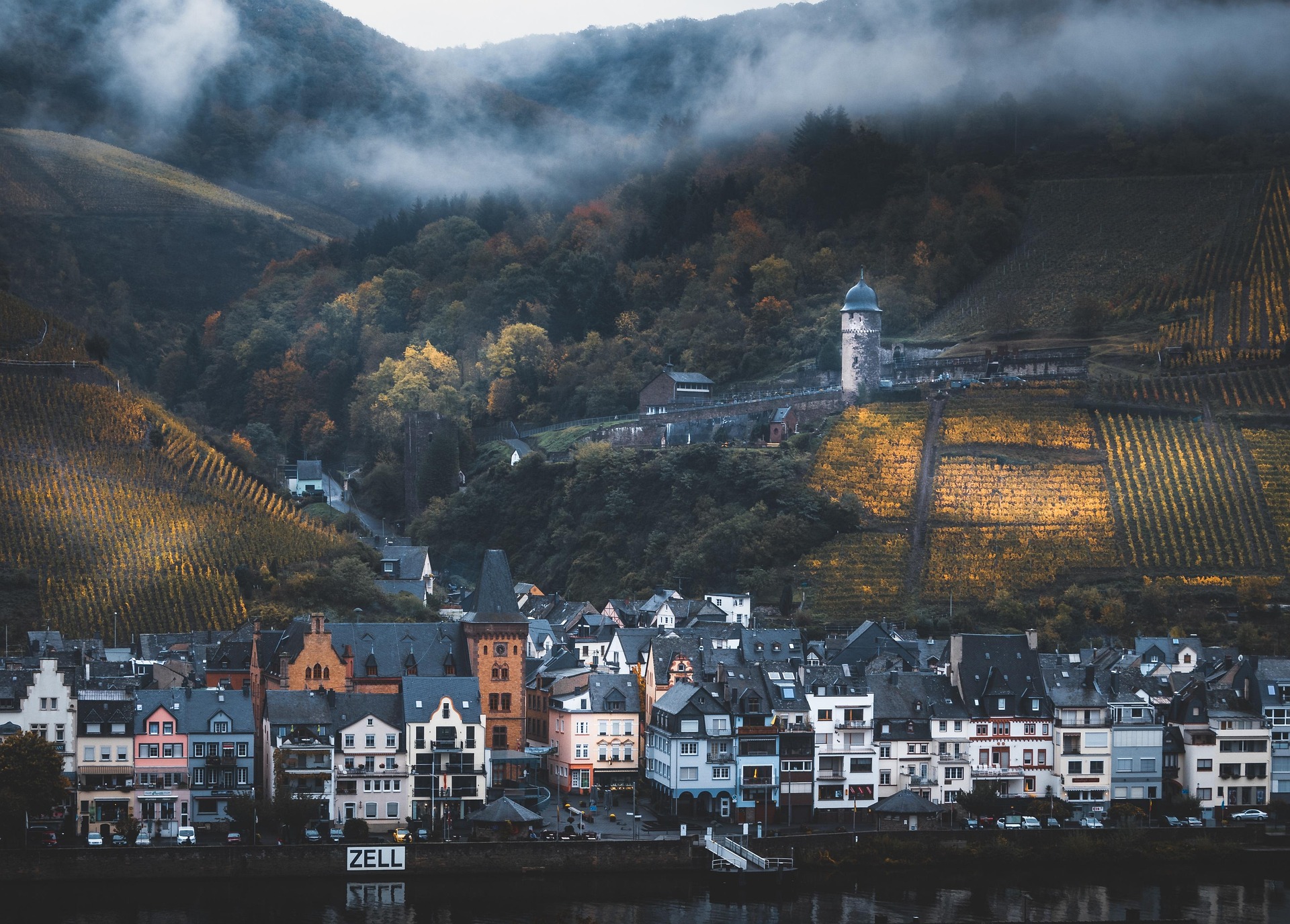
Two hundred kilometers and one border separate them. Both grow Riesling on steep mineral soils at the high northern edge of Europe's wine map. Both have built a critical reputation on a single grape. And yet, opened side by side, the Mosel Riesling and the Alsace Riesling do not taste like cousins. They taste like opposing arguments about what the grape is for.
The shared thread
Riesling is the grape that mistrusts intervention. It carries acidity like a load-bearing wall, holds onto its variety markers no matter how cold the cellar or how late the harvest, and is one of the very few white grapes that gains rather than loses character in bottle for thirty years. Both regions found this out independently and built their identities on it. The Mosel runs along its eponymous river through Germany; Alsace sits across the Vosges and the French border, on the other side of the Rhine plain. Latitude bands them within a degree of each other. Soils are the first divergence (the Mosel is famous for blue and grey Devonian slate, Alsace for a mosaic of granite, limestone, schist, and volcanic rock), and that divergence shapes what comes next.
Mosel: the language of sweetness
Mosel bends itself around the Riesling vine. 2,084 estates in the Femente index produce it, against Alsace's 1,050; the region indexes 12,972 Rieslings, almost three times Alsace's 4,546. Ninety-seven Mosel estates carry FEM 90 or higher, two reach 95. The vineyards are theatrical: pitches up to 60° on slate slopes that have to be worked by hand, looking down to a river that loops back on itself for the warmth.
The defining Mosel statement is the Auslese: late-picked, off-dry to sweet, capable of fifty years in cellar. Joh. Jos. Prüm's Wehlener Sonnenuhr Auslese pulled 100 from Falstaff and 99 from Wine Spectator. Egon Müller - Scharzhof's Scharzhofberger Auslese 'Goldkapsel' drew 100 from Wine Advocate, and a sister bottling (the Wiltinger Braune Kupp Auslese) matched it at 100. Markus Molitor's Wehlener Sonnenuhr Auslese *** Goldkapsel rounds out three perfect Wine Advocate scores from a single river bend.
The dry side is rising too. Selbach-Oster and Forstmeister Geltz-Zilliken sit at 99 from Decanter for their Trocken (dry) bottlings, a generation of producers proving that Mosel Riesling can stay bone dry without losing the slate-stone signal. Dr. Loosen's Erdener Prälat Auslese Goldkapsel takes 98 from Wine Enthusiast for the sweet style, the same producer also exporting bone-dry Estate Rieslings at scale.
Alsace: the language of dryness
Alsace Riesling is built on the opposite premise. The dry style is default; sugar is the exception. The classification system underwrites it: the Alsace Grand Cru tier names 51 specific climats (vineyard sites) where Riesling, along with three other "noble" grapes, can be bottled with the cru name on the label. France codified the system over the 1970s and 1980s, late by Burgundian standards but with the same logic: the vineyard, not the village, is the unit.
Domaine Zind Humbrecht defines the modern Alsace top end. The Riesling Clos Windsbuhl pulled 99 from Wine Advocate; the Riesling Grand Cru Rangen de Thann Clos Saint Urbain landed 98 from Wine Advocate, 97 from Decanter, and 97 from Wine Enthusiast across the same vintage cycle. Albert Boxler's Sommerberg and Brand Kirchberg Grand Cru bottlings sit at 97 from Decanter. Trimbach's Cuvée Frédéric Emile (a non-Grand-Cru cuvée from declassified Geisberg and Osterberg parcels) holds 96 from Wine Spectator and is the canonical proof that the Alsace dry style does not need a Grand Cru label to land in the prestige tier. Marc Kreydenweiss's Kastelberg Grand Cru pulls 97 from Wine Enthusiast on schist soils that taste of nothing else in the region.
The Alsace top end is concentrated. Forty-six estates carry FEM 90 or higher; three reach 95. That's a smaller pool than the Mosel's 97 and 2, but it's a different shape: the Alsace high tier is a tighter cluster of more-prestige bottles per estate.
Where they diverge
The keyword data names the divergence in one line. Mosel's leading tasting descriptor across 12,972 indexed Rieslings is Honey. Alsace's, across 4,546 Rieslings, is Citrus. Both regions share the next four (Minerals, Apple, Lemon, Pear), but the order in which they present, and what comes around them, is opposite. Mosel chases lift, mineral honey, and the apricot-honeysuckle band that the Auslese style cultivates. Alsace pulls toward the lemon-pith, flint, and petrol note that comes out of bone-dry, sun-driven Riesling on warm soils. Same grape. Opposite signal.
The system around the bottle differs too. Mosel's hierarchy is the Prädikat ladder (Kabinett, Spätlese, Auslese, Beerenauslese), which classifies by ripeness at harvest and, by old reading, by sweetness in the bottle. Alsace's hierarchy is the Grand Cru, which classifies by vineyard. One says: tell me how ripe the grape was. The other says: tell me where it grew.
Where to start
Two entry points. From the Mosel, Selbach-Oster's Riesling Trocken, 99 from Decanter, dry, the modern face of the region without the Auslese cellar wait. From Alsace, Trimbach's Cuvée Frédéric Emile, 96 from Wine Spectator, dry, no Grand Cru on the label, but the bottle that has converted more skeptics to Alsace than any other. Drink the Mosel first to hear what cool slate does to Riesling. Drink the Alsace second to hear what warm granite and limestone does. Same grape. Two completely different conversations.