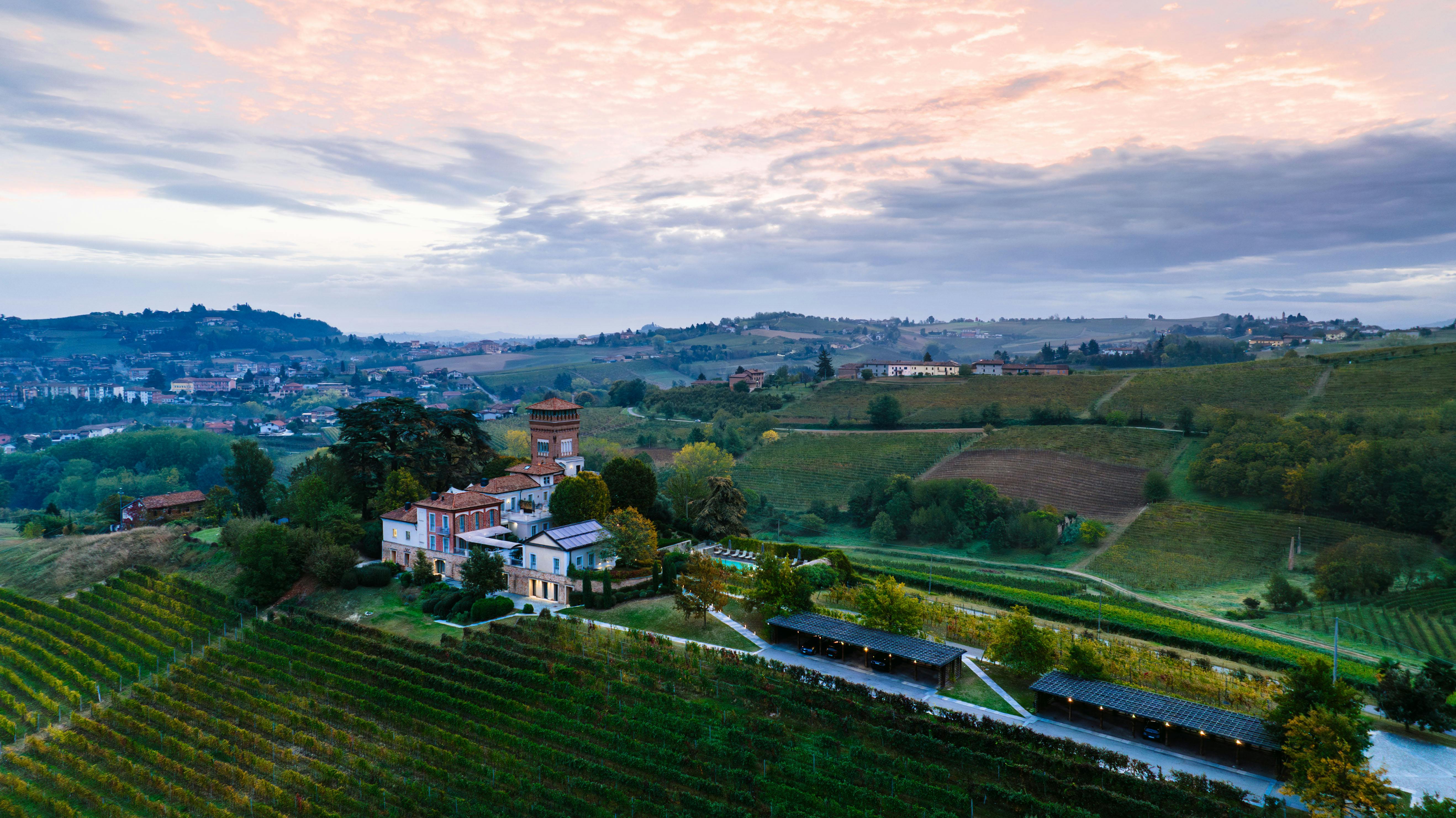
Barolo and Brunello are different grapes (Nebbiolo in Piemonte, Sangiovese in Tuscany) grown four hundred kilometers apart, on different soils, by two regional traditions that almost never speak to each other. They share almost nothing except a job description: be Italy's most prestigious red, and prove it with patience. Both demand five-plus years of aging before they can be sold under the appellation's name. Both reward thirty years in cellar. And the data shows the styles converge in the body of the wine, and split, sharply, in the descriptors that the regions own.
The shared thread
Both regions enforce one of Europe's strictest aging laws on their flagship wine. Barolo requires 38 months of aging before release (62 months for the Riserva), with at least 18 of those in oak. Brunello di Montalcino requires 60 months of aging (72 for the Riserva), with at least 24 in oak. The first commercial vintage of both wines arrives only after the third growing season has passed. This is unusual at the system level: most appellations enforce no minimum aging at all. The intent is the same in both: let the tannin resolve before the wine reaches the table.
The other shared thread is climate against altitude. The Langhe hills of Piemonte and the Montalcino plateau of Tuscany both sit at altitude, both have the diurnal temperature swings that allow late-ripening grapes to keep their acidity, and both have soils that are calcareous-clay-marl mixes, the same family of substrates, just at opposite ends of the country.
Barolo: Nebbiolo's austerity
Barolo is built on Nebbiolo, a grape that does not travel well, that won't ripen below 350 metres in many vintages, and that arrives in glass with one of the highest acid-and-tannin payloads of any red variety. The Femente index counts 249 estates producing Nebbiolo across the appellation, 946 indexed Barolos, 25 producers at FEM 90 or higher, one above 95.
Top picks span the modern-vs-traditional divide. Giuseppe Rinaldi's Brunate Barolo pulled 100 from Decanter, Rinaldi being one of the canonical traditionalists of La Morra, large-cask aging, no compromise. Brovia's Brea Vigna Ca'Mia Barolo matched at 100 from Decanter, working from a single vineyard in Serralunga d'Alba. Paolo Scavino's Bric Dël Fiasc took 100 from Wine Enthusiast and the Rocche dell'Annunziata Riserva 99 from Wine Spectator. Scavino sits on the modernist end, with shorter macerations and some new wood, but still inside the Nebbiolo line. Giovanni Rosso's Vigna Rionda Ester Canale draws 99 from Falstaff. Camerano's straight Barolo lands a 100 from Wine Advocate.
The Barolo tasting signature, across nearly a thousand indexed wines, is the cohort of Cherry, Leather, Oak, Earthy, Tobacco, and then Tar, Licorice. The last two are the things wine writers reach for when describing nothing else. Tar is the Nebbiolo signature; few other red wines develop it.
Brunello: Sangiovese's patience
Brunello di Montalcino is built on a single clone of Sangiovese, locally called Sangiovese Grosso, that the nineteenth-century producer Clemente Santi isolated and propagated in Montalcino, and that the Biondi-Santi family commercialized as Brunello, registering it as a distinct variety. The appellation is small: 110 producers in the Femente index, 282 indexed Brunellos, 41 estates at FEM 90 or higher, one above 95.
The top end is concentrated in a few names. Poggio Landi appears across three critics: Decanter (97), Wine Spectator (99 for the Riserva), Wine Enthusiast (100 for the Riserva). Tenuta Pian delle Ginestre's Brunello di Montalcino takes 100 from Wine Advocate. Talenti's Brunello holds 95 from Falstaff. Renieri appears across the Wine Spectator and Wine Enthusiast top sets at 99 and 100 for the Riserva.
The Brunello tasting signature shares Cherry, Leather, Oak, Earthy, Tobacco with Barolo, and then diverges into Plum, Vanilla, and Blackberry. The fruit profile is fuller, riper, and darker. The wood is more often new oak (small French barriques) rather than Barolo's traditional Slovenian large casks, which adds vanilla and blunts a small amount of the savoury edge.
Where they diverge
The fruit-and-tannin character is the structural divide. Nebbiolo is light in the glass, pale garnet, almost translucent, but heavy in the mouth. The tannins arrive young and aggressive, the acidity is sharp, and the wine demands time. Sangiovese in Brunello is fuller-bodied, deeper-coloured, with rounder tannins and a fruitier first impression. The aging requirements equalize them on release date but not on profile: a young Brunello is more approachable than a young Barolo, even when both wines are eight years from harvest.
The economics differ too. Barolo's 25-producer ceiling above FEM 90 is a smaller absolute number than Brunello's 41, but Barolo's index also has many more wines per producer (946 wines / 249 producers = 3.8) than Brunello (282 / 110 = 2.6). Brunello producers are typically narrower specialists: most of the appellation's estates make almost nothing else under the Brunello label. Barolo producers are broader: many in the index also produce Barbaresco, Langhe Nebbiolo, and Dolcetto.
Where to start
Two entry points. From Barolo, Paolo Scavino's Bric Dël Fiasc Barolo (100 Wine Enthusiast): modern-leaning, single-vineyard, the kind of Barolo that does not require thirty years of patience to be drinkable. From Brunello, Talenti's Brunello di Montalcino (95 Falstaff): classical Montalcino, large-format aging, no shortcuts. Drink the Barolo first to hear what tar and licorice do to a red wine. Drink the Brunello second to hear how plum and blackberry round the same Italian-flagship signature into something darker and softer. Same job. Two completely different ways of doing it.