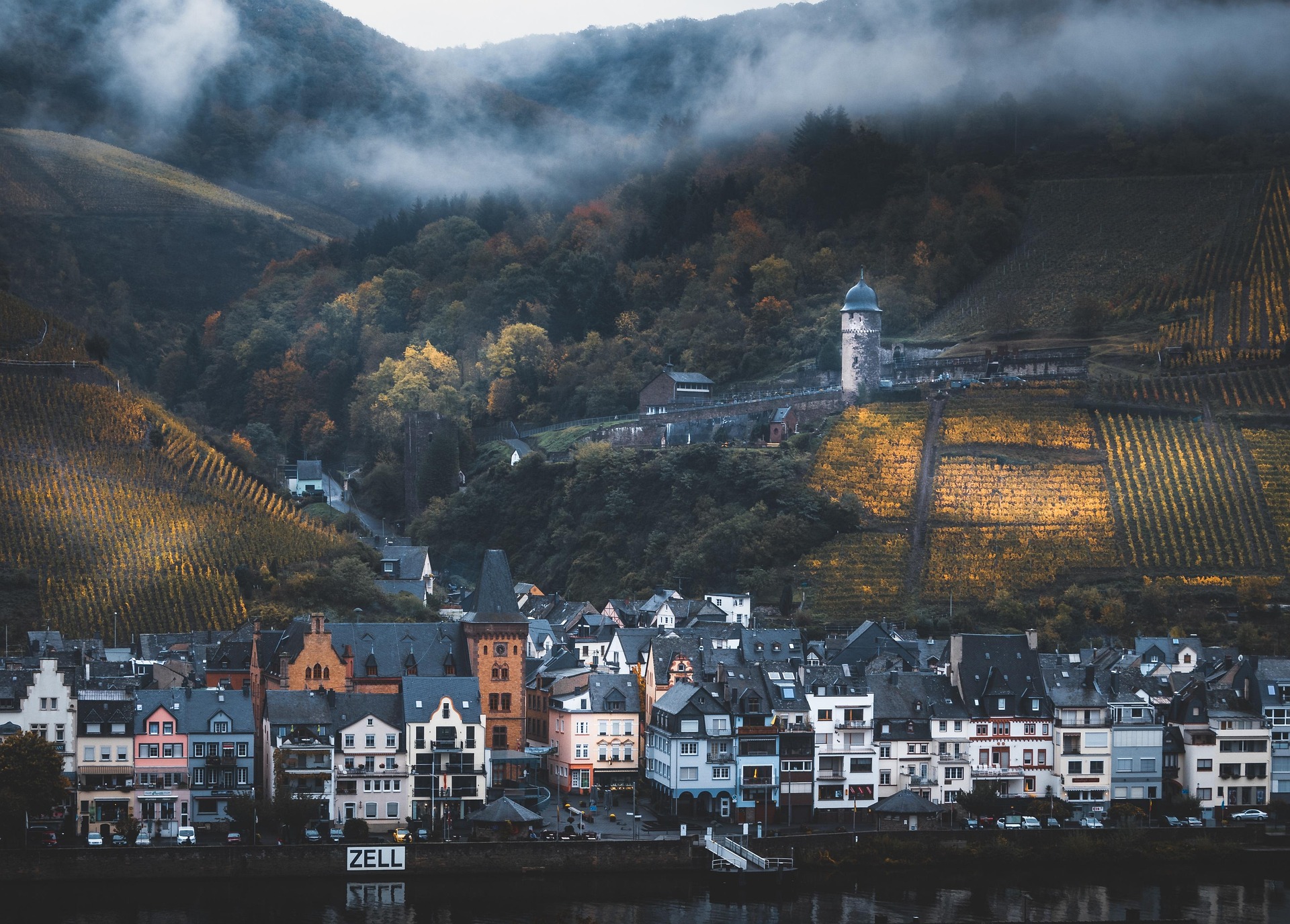
The Mosel has 84 years of continuous weather data in the Femente record, one entry per year going back to 1941, each carrying the basic vital signs of the growing season: how warm the summer was, how much rain fell, how thirsty the vines went, how much sunshine arrived, whether the heat ever climbed dangerously high. Joined to the prestige critics' Riesling scores, the record becomes one of the few places in wine where you can actually watch climate and rating moving together. We picked one grape (Riesling) in one region, and walked the last twenty-two vintages.
What we have to work with
Eighty-four years of weather. Twenty-two vintages with enough indexed Riesling ratings to be statistically real: over 18,000 ratings in total from Wine Advocate, Decanter, Wine Spectator, Wine Enthusiast, and Falstaff. The Mosel is one of the most-rated cool-climate regions in the index, which makes it a clean canvas for this kind of question. What changed in the wine, and what changed in the weather, and do the two lines on the chart move together?
The cool reference: 2001
2001 was the coolest summer in the Mosel record across our 22-year window, a long, slow, classically cool growing season. Rain came at the textbook level, the vines drank what fell, and nothing was forced. The prestige-critic average for that vintage's Riesling came in at 89.6 across 467 ratings, a solid, classical Mosel score. Nothing extraordinary, nothing penalised. The cellar work that producers like Joh. Jos. Prüm and Egon Müller - Scharzhof had spent decades calibrating to cool seasons did its job, and the bottle reflected it.
The 2003 paradox
2003 is famous outside the wine world too, the European heatwave that killed tens of thousands. In the Mosel record it shows as the hottest year of the 2000-2014 era by a wide margin, with the deepest drought of any year in our window. By every weather measure it was an extreme summer for the region.
The press releases at the time celebrated it as a historic vintage. The data tells a more complicated story. The 2003 average prestige-critic rating for Mosel Riesling came in at 88.5 across 389 ratings, lower than the 2001-2002 baseline, and lower than every Mosel vintage that has followed it. The grape did not love the stress as much as the marketing said. Riesling depends on slow ripening and acid retention; pull both away and you get wines that taste competent rather than transcendent.
The producers who handled it best (Markus Molitor, Forstmeister Geltz-Zilliken) were the ones who picked early enough to keep acidity in the bottle. The producers who waited for sugar got hot wines. The 2003 vintage rewards specific producer skill more than it rewards the region.
The cool-wet exception: 2010
2010 is the inverse case. One of the coolest summers in the window. The wettest year in the entire record, by some margin. The only year of the 22 in which the vines ended the season with rainfall surplus rather than deficit. By the conventional reading, that should be a difficult vintage: cool, wet, hard to ripen.
The prestige-critic average for 2010 Riesling came in at 90.0 across 1,122 ratings, half a point above the period baseline. Wet, cool years are exactly what late-harvest Mosel Riesling was historically built for. Prüm's Sonnenuhr Auslese style needs slow ripening and noble rot; 2010 supplied both. The 2003 paradox is mirrored here: the year that looks hard for vines on paper is the year the region's traditional style works best.
The modern warm era: 2015-2022
The clearest pattern in the data is not any single vintage. It's the shift in baseline. Across the 2000-2014 period, the prestige-critic average for Mosel Riesling sat at 89.5. From 2015 onward, the same average sits at 91.0, a one-point-five jump that holds across seven consecutive vintages.
The weather record shows the corresponding shift. Summers got warmer. The dry-vs-wet swing got wider. 2018 set the regional record for warmth (the warmest growing season the Mosel has ever recorded), and the rating average for that vintage was 90.4. 2019 hit 91.3 on a similarly warm-and-dry year. 2022 hit 91.4, the highest in the record, and the first year in eighty-one years of continuous data with a registered scorching day in the Mosel.
Selbach-Oster, Dr. Loosen, and Markus Molitor have all described this period as a regional rewrite: the Trocken (dry) style that was once a struggle in cool years now arrives ripe and balanced almost annually. The Mosel was for two centuries the cool-edge limit of viable Riesling. It is now, on the data, somewhere different entirely.
A few honest caveats
Three things to be clear about. First, the score lift from 2014 to 2015 onward isn't all weather: the producers got better at the same time, especially in the dry style, and critic attention to the Mosel expanded too. The line on the rating chart isn't purely climate.
Second, when scores cluster at the top of a 100-point scale, a 91 versus a 90 isn't a huge mechanical difference. It's a soft signal pointing in a real direction, but it's not a ten-point gap on a ten-point scale.
Third, weather hits different producers differently. The average across the whole region hides the variation. A given hot vintage might be one producer's masterpiece and another producer's misfire, depending on when they picked.
The data still tells one clear story: the Mosel that the prestige critics rated highest in our 22-year window is the Mosel that has been measurably warmer than the historical norm.
Where to start
Three vintages, three weather signatures, three entry points.
From the cool reference, Joh. Jos. Prüm's Wehlener Sonnenuhr Riesling Auslese from a classic cool year (2001 or 2010 if you can find it), the Auslese style at its slow-ripened best. From the modern warm era, Markus Molitor's Wehlener Sonnenuhr Riesling Auslese *** Goldkapsel from 2018 or 2019, the same vineyard, the same producer, in a Mosel summer that did not exist ten years before. From the dry side, Selbach-Oster's Riesling Trocken from 2019 or 2020, the bone-dry style that the warm era has made consistently possible. Drink them in chronological order. The grape will not change. The summer that made it will.