Dessert wines win more 100-point scores per producer than almost any other category in the prestige-critic data. Château d'Yquem alone has more perfect scores in our index than many entire dry-wine appellations. Sauternes, Tokaji Aszú, vintage Port, and Trockenbeerenauslese Riesling are routine prestige material; the wines age longer than nearly any other wine style; and they sell for a fraction of the price of equivalent dry-wine prestige.
The category is criminally undervalued in modern Western drinking culture. Sweet-labelled wine lost 90% of its prestige market share between the 1970s and the 2000s, even as the wines themselves continued to score among the highest-rated bottles produced anywhere. The trend is reversing slowly. For a serious drinker, the dessert-wine category is one of the few remaining places in the wine world where prestige quality is sold at non-prestige prices.
The four sweetness mechanisms
Sweet wine gets its sugar in one of four ways. Each produces a structurally different wine even when the residual sugar level is the same, and recognising which mechanism is in the glass is the first move in understanding any specific bottle.
Noble rot (Botrytis cinerea, the same fungus that ruins grapes in wet years) is the most prestigious mechanism. Under the right conditions (morning mist that wakes the fungus, afternoon sun that dries it out), botrytis pierces the grape skin and dehydrates the berry from the inside, concentrating the sugar, the acid, and the aromatics simultaneously. The fungus also produces its own metabolites (glycerol, gluconic acid, and a specific honeyed-saffron-marmalade aromatic compound) that no other sweetness mechanism delivers. Sauternes, Tokaji Aszú, Trockenbeerenauslese, and Sélection de Grains Nobles all rely on botrytis.
Late harvest is the simpler version. The grapes are left on the vine past normal ripeness, the water evaporates naturally through the skin, and the sugar concentrates. There is no fungal intervention. The wines retain pure fruit character (no botrytis honey notes) and the structural style is cleaner but less complex. Alsace Vendange Tardive, German Auslese (when not botrytised), and most New World late-harvest wines fall here.
Frozen-grape pressing (Eiswein in Germany and Austria, Icewine in Canada) leaves the grapes on the vine through the first hard frost of winter and presses them while still frozen. The water in the grapes crystallises and is filtered out by the press; only the concentrated sugar-rich juice enters the cellar. Eiswein has higher acidity than botrytised wines of the same sugar level, cleaner fruit definition, and a more linear structural profile. The trade-off is aromatic complexity: frozen-grape wines are pure but less layered than botrytised ones.
Fortification stops the fermentation early by adding neutral grape spirit. The yeast can't survive the alcohol increase, so the unfermented sugar stays in the wine. Port, Madeira, Banyuls, Maury, and the broader Vin Doux Naturel category all use this mechanism. The wines have higher alcohol (usually 18-22%) than the other three categories and a longer ageing trajectory because the spirit acts as a preservative.
Sauternes: the Bordeaux apex
The Sauternes appellation, on the south bank of the Garonne river upstream of Bordeaux, is the world's reference point for botrytised sweet wine. The geography matters: the river meets a cooler tributary (the Ciron) which produces the morning mists, and the broader Sauternes geography catches afternoon sun reliably enough that the botrytis cycle completes properly in most vintages.
The grape blend is Sémillon-led, typically 80% Sémillon with the balance in Sauvignon Blanc and a small amount of Muscadelle. Sémillon's thin skin is uniquely susceptible to botrytis; Sauvignon Blanc adds aromatic lift and acid; Muscadelle (used sparingly) adds floral aromatics. The picking is done in multiple passes through the vineyard (the tries) where workers select only the individual berries that have fully botrytised, leaving the rest to develop further or be lost.
Château d'Yquem is the reference point and the only Premier Cru Supérieur classified property, a tier above the rest of the Sauternes hierarchy. Its prestige-critic record is extraordinary; the wine is in our index with multiple perfect scores across the major critics. The supporting cast at the prestige tier (Climens, Suduiraut, Rieussec, Coutet, Guiraud, La Tour Blanche) produces wines that score in the same prestige band at half the price of d'Yquem. Château de Fargues (owned by the Lur-Saluces family, who formerly owned d'Yquem) and Château Gilette (famous for releasing wines only after 15-20 years of barrel ageing) are the prestige Sauternes producers in our index, both with strong prestige-critic records on serious vintages. Sauternes from a great vintage (2001, 2009, 2011, 2015) can age 50+ years; the wines develop deeper amber colour, marmalade and dried-fig notes, and increased complexity over decades.
The structural reason Sauternes works as the apex of the category: the climate consistency. Botrytis is unreliable. Most regions that try to produce noble-rot wines only succeed in 2-3 vintages per decade. Sauternes succeeds nearly every year because the Ciron-Garonne mist geography is structurally reliable. Volume is high enough to support 25+ serious producers; quality is consistent enough to support the prestige hierarchy.
Tokaji Aszú: the Hungarian original
The historical claim: Tokaj-Hegyalja, in northeastern Hungary, was the first regulated wine region in the world, formally classified in 1737, predating Bordeaux's 1855 classification by more than a century. The botrytised sweet wine produced there, Tokaji Aszú, was the diplomatic gift of European royalty for two centuries, served at the courts of Louis XIV, the Romanovs, and the Habsburgs.
The grape varieties are Furmint (the structural grape, high in acid and tightly skinned), Hárslevelű (a softer, more aromatic grape), and small quantities of Sárgamuskotály (a Muscat variant). The sweetness scale runs on the puttonyos system, which originally measured the number of hods of botrytised berries (aszú berries) added to a barrel of dry base wine: 3 puttonyos was the entry level, 6 puttonyos the standard high end, and Aszú-Eszencia and Eszencia sat at the top. Modern Tokaji simplified the system in 2014: 5 puttonyos is now the minimum, 6 puttonyos remains the main commercial grade, and Eszencia (essence pressed only by the weight of the berries themselves, often with 500-700 g/L of residual sugar) is the legendary peak.
The wines have a structural profile different from Sauternes: higher acid (Furmint's signature), more apricot and dried-mandarin character, and less of the glycerol-honey weight that Sémillon delivers. Tokaji ages exceptionally well. Bottles from the 1960s and earlier are still being opened at auction and drinking properly.
The category survived Soviet-era industrial winemaking (which produced low-quality export Tokaji that nearly destroyed the appellation's reputation) and came back to prestige tier through heavy post-1989 reinvestment. Producers like Disznókő, Royal Tokaji, Oremus, and Szepsy led the revival. Modern Tokaji at the 6 puttonyos tier sells for €60-150 and is one of the clearest underpriced prestige plays in the wine market.
Port: the Douro fortified
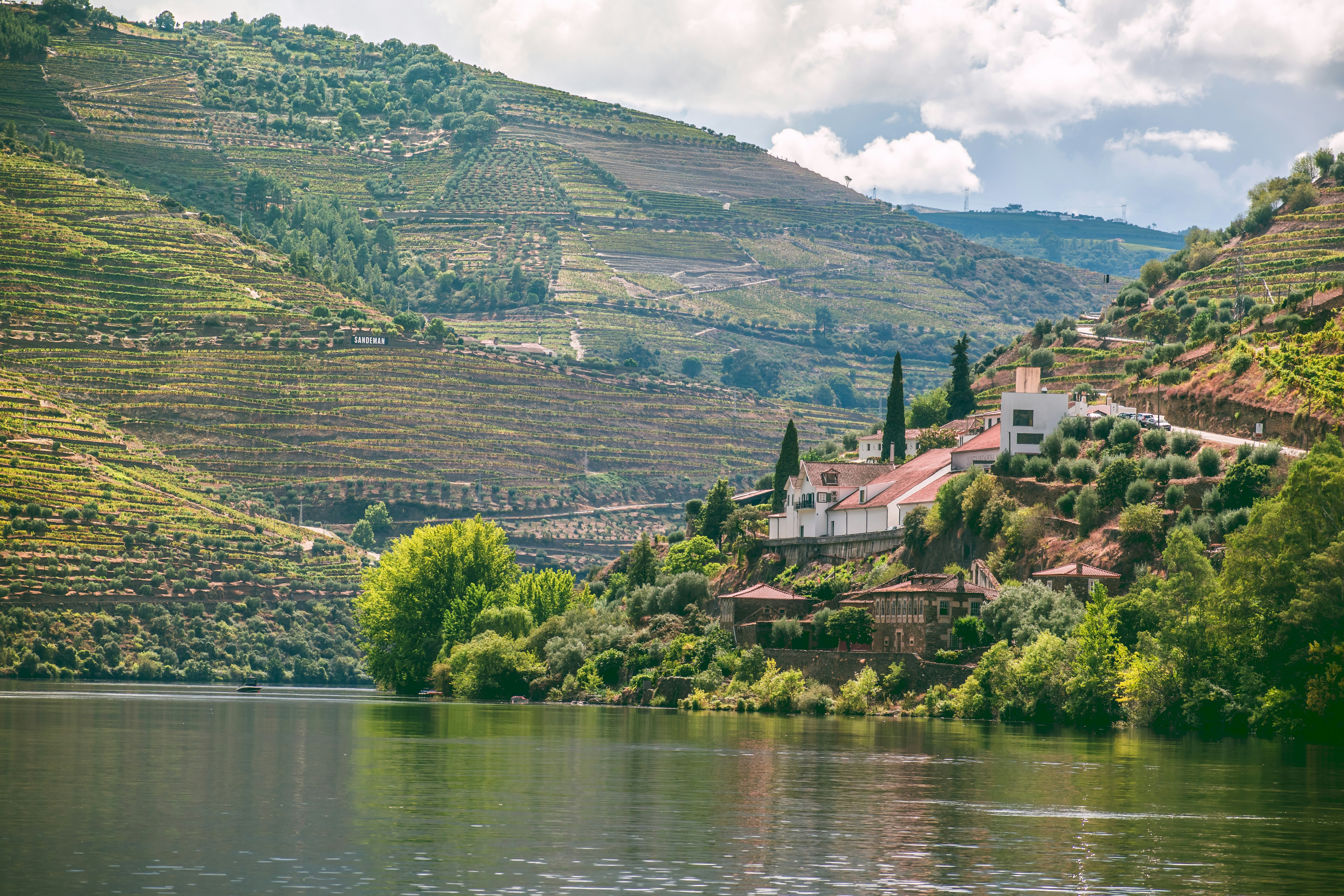
The Douro Valley in northern Portugal is the world's oldest demarcated wine region for fortified wine, formally defined in 1756. Port is made from a field blend of indigenous Portuguese grapes, Touriga Nacional (the structural grape), Touriga Franca (the volume grape), Tinta Roriz (the same grape as Tempranillo), Tinta Barroca, and Tinto Cão, vinified together in the traditional quintas of the upper Douro, where the river cuts through steep schist terraces.
Fortification is done partway through fermentation by adding neutral grape spirit (aguardente vínica), which kills the yeast and locks in the remaining sugar. The wine is then aged in either bottle or wood, depending on the style. Vintage Port (made only in declared years, when the producer's house decides the vintage is good enough to commit to) ages in bottle for decades, develops a deep concentrated character, and is the most prestigious tier. Late Bottled Vintage (LBV) is from a single year but bottled later and is meant to be drunk on release. Tawny Port is aged in wood (10, 20, 30, or 40 years average age), develops oxidative character (caramel, nuts, dried fig) and is one of the most food-friendly wines in the prestige category.
Quinta do Noval holds a distinction we covered in The 100-Point Club: the only winery in our entire index with a 100-point score from all five major prestige critics, for their Vintage Port Nacional, a single-vineyard, ungrafted-vine Port that's released only in exceptional years. The supporting cast in our index at the prestige tier is broad: Niepoort sits at the top of the producer hierarchy alongside Noval, and the Symington family stable contributes Quinta do Vesuvio (an isolated upper-Douro single quinta) alongside their better-known Graham's and Dow's labels. Quinta do Crasto, Quinta do Vale Meão, Quinta do Fojo, and Quinta da Boavista are the other established names. All produce vintage Ports that score consistently in the prestige tier and age 30-50 years in bottle, and most also produce serious dry Douro reds covered in our Douro Valley Wine Tour piece.
For the Douro region context and the broader transition Port producers have made into serious dry red wine over the last two decades, see our Douro Valley Wine Tour piece.
Madeira: the indestructible
Madeira is the wine that doesn't die. A bottle opened in 1850 and tasted in 2025 is still drinkable: the structural integrity of the wine survives nearly any storage condition, including heat and oxidation that would destroy any other wine.
The reason is the estufagem process. After fortification, Madeira is intentionally heated, historically through hot-cellar storage near the equator on the way to colonial markets, now through controlled heating in estufas (heated tanks), for months to years. The heat caramelises the wine, oxidises it, and produces a chemical structure that's already gone through every degradation pathway a normal wine would face. The result: a wine that can't be ruined further by time.
The grape varieties run from driest to sweetest: Sercial (bone-dry), Verdelho (off-dry), Bual (medium-sweet), and Malmsey (the sweetest, made from Malvasia). Each variety produces a structurally different wine: Sercial is almost like a fortified Manzanilla Sherry, Malmsey like a more elegant fortified PX. All four can be aged 10, 20, 30, 40+ years and labelled accordingly.
The price-per-quality ratio is the most extreme in the entire wine market. A 20-year-old Madeira from a top producer (Barbeito, Henriques & Henriques, Blandy's, D'Oliveiras) sells for €50-100. The same age and quality tier in Tawny Port costs roughly twice as much. The same prestige level in any non-fortified wine costs five times as much. The category survives on a small enthusiast market that is structurally undersized relative to the quality the wines deliver.
German sweet wines: Auslese, BA, TBA, Eiswein
The German Prädikat scale is the most rigorous ripeness classification in the world. From driest to sweetest: Kabinett (the lightest, lowest must-weight ripeness), Spätlese (late harvest, riper but often still dry-style), Auslese (selected harvest, can be dry or sweet, often partially botrytised), Beerenauslese (BA: individual berry selection, always sweet, usually botrytised), and Trockenbeerenauslese (TBA: dried-berry selection, always sweet, fully botrytised, the prestige peak). Eiswein sits outside the ripeness sequence: it requires both the high must-weight of BA and the additional concentration of frozen-grape pressing.
The structural distinction worth knowing: Auslese can be either dry or sweet depending on the producer, but BA, TBA, and Eiswein are always sweet by definition. A TBA from a top Mosel or Rheingau producer is the German prestige equivalent of a top Sauternes: same botrytis mechanism, different grape (Riesling instead of Sémillon), different terroir (slate instead of limestone), structurally a different wine but in the same prestige league.
Riesling is the dominant grape for German sweet wines and produces the most age-worthy expressions; the wines hold acid through decades of cellar ageing. Selbach-Oster's Zeltinger Sonnenuhr Riesling TBA from the 2018 vintage scored 100 from Wine Advocate, as covered in our 2018 Vintage Across Europe piece, a perfect example of how a hot, dry growing season produces the conditions for a generational sweet wine. Joh. Jos. Prüm is the prestige reference for Mosel Auslese and above; Dr. Loosen covers the prestige tier across multiple Mosel sites; Forstmeister Geltz-Zilliken on the Saar is the producer to know for prestige sweet Saar Rieslings with the cleanest acid backbone of any German sweet wine.
From Alsace, the French analogue is Sélection de Grains Nobles (SGN), also botrytis-driven, also typically Riesling or Gewürztraminer or Pinot Gris, with slightly less acid and slightly more aromatic weight than the German equivalents. Domaine Weinbach, Domaine Zind-Humbrecht, and Marc Kreydenweiss are the prestige SGN producers in our index, all with strong prestige-critic records on serious vintages.
Icewine and Eiswein: the cold-climate concentrator
Germany and Austria produce Eiswein (the original style); Canada produces Icewine at the largest commercial volume globally. The Inniskillin and Peller Estates wineries in Ontario built the Canadian Icewine category in the 1980s and 1990s, capitalising on Niagara's reliable hard winters where the European producers were already struggling with climate variability.
The process: grapes are left on the vine through November and December, attached to nets to protect them from birds and the wind, until a hard frost of -8°C or lower freezes them solid. The frozen grapes are picked at night (when temperature is reliable) and pressed while still frozen. The water content crystallises and stays in the press; only the concentrated sugar-and-flavour juice flows through.
The structural difference from botrytised wines: Eiswein has very high acid (the water concentration is uniform across the grape, so the acid concentration matches the sugar concentration), no fungal complexity (no honey, no saffron, no botrytis weight), and a cleaner, more linear flavour structure. The wines are excellent young but don't age as long as Sauternes or TBA: the cleanness that makes them attractive at release also limits their decades-out development.
Beyond Port: fortified sweets
The fortified-sweet category extends well beyond Port and Madeira. Banyuls and Maury are French fortified sweet wines from Roussillon in the Pyrenees foothills, both made from Grenache, both structurally similar to Vintage Port but with a distinct herbal-Mediterranean character. Vin Doux Naturel (VDN) is the broader French category that includes Banyuls, Maury, Rasteau, Beaumes-de-Venise, and several Muscat-based VDNs. Each has a defining grape and a defining sweetness profile.
Pedro Ximénez (PX) from Andalusia is the densest sweet wine in the world by sugar concentration. The PX grape is dried in the sun on straw mats (the paseras) until it reaches raisin-like sugar levels, then pressed and fortified. The resulting wine has 400+ g/L of residual sugar (twice the sweetness of most Sauternes) and a viscosity closer to syrup than to wine. PX paired with vanilla ice cream is the canonical decadent dessert; the wine is also extraordinary with dark chocolate and with aged blue cheese.
Vin Santo from Tuscany is the Italian dried-grape sweet wine. The grapes (typically Trebbiano and Malvasia) are dried on straw mats indoors for months, pressed to a low-yield concentrated must, fermented slowly in small barrels (caratelli), and aged for years before bottling. The structural style is oxidative, nutty, somewhere between Madeira and PX in character. Cantucci with Vin Santo is the Tuscan dessert pairing it was invented for.
How to choose
The simplified decision tree, by pairing context:
- With foie gras → young Sauternes (the textbook), or 5-puttonyos Tokaji Aszú
- With blue cheese → Sauternes, Vintage Port, or PX (each works for different cheeses: Sauternes for Roquefort, Port for Stilton, PX for an aged Gorgonzola)
- With dark chocolate → Vintage Port, PX, or Banyuls
- With fruit desserts → German Auslese or Spätlese, or late-harvest Riesling
- With Christmas pudding, fruitcake → Tawny Port (20-year), Madeira (Bual or Malmsey)
- As a meditation wine, by itself after dinner → aged Madeira, Tokaji 6 Puttonyos, or vintage Sauternes
- For long-term cellaring → declared-vintage Port (drinks well at 25-50 years), top Sauternes (40+ years), or TBA Riesling (40+ years)
Why dessert wines score so high
The structural reason dessert wines dominate the perfect-score data: botrytis concentrates everything. Sugar, acid, aromatic compounds, glycerol, mineral compounds: all are multiplied 2-3× by the dehydration that fungal infection produces. The resulting wine has more of every dimension a critic measures than its dry counterpart from the same vineyard in the same vintage. A Sauternes scores 100 and a dry Bordeaux blanc from the same property scores 92 because the Sauternes is, in the most literal sense, a more concentrated version of the same wine.
This is why the perfect-score data we covered in The 100-Point Club shows such heavy clustering in dessert categories (Sauternes, vintage Port, top TBA Riesling, Tokaji Aszú) relative to their share of total wine production. The prestige critics aren't biased toward sweet wine; the wines are structurally denser and the scoring is the natural consequence.
Where to start
For the everyday dessert-wine option: a half-bottle of Sauternes from Château de Fargues (€30-60 for 375ml), or a Mosel Auslese from Selbach-Oster or Dr. Loosen (€25-40 for 750ml). Both deliver prestige-tier sweetness for less than a decent dry-wine equivalent.
For a serious sweet wine: a Tokaji 6 Puttonyos from Disznókő, Royal Tokaji, or Szepsy (€60-100), or a vintage Port from a declared year by a top house: Quinta do Noval, Niepoort, or Quinta do Vesuvio all sit in the €80-150 band for declared vintages.
For the long-term cellar play: a long-aged vintage Sauternes from Château Gilette (released after 15-20 years of barrel ageing, €150-300), a TBA Riesling from Joh. Jos. Prüm or Selbach-Oster (€200+ for a half-bottle in serious vintages), or a Quinta do Noval Vintage Port in a declared year (the Nacional if available, the standard vintage otherwise: the wine ages 50+ years and is one of the few sweet wines that genuinely improves into its second half-century).
For the value play in the entire dessert-wine category: aged Madeira. A 20-year Bual or Malmsey at €80 will outscore most Sauternes at twice the price, will age another fifty years in the bottle, and will pair more flexibly with food than nearly any wine in the prestige category. The category's low fame is a buying opportunity.
For the cross-reference data, The 100-Point Club shows the perfect-score concentration in this category and names the producers worth following. For the regional context on the two most prestige-loaded dessert categories, see Bordeaux for Sauternes and Douro for Port.