Sparkling wine is a category defined by how the wine is made, not where it's grown. Champagne and Prosecco are different not because of grapes or terroir (they share no grape varieties and grow on different continents geologically) but because their secondary fermentation happens in different containers. Cava and Crémant are different from Champagne not because of the grape or the soil but because of the appellation rules; the production method is the same. Understanding sparkling wine starts with understanding which method is in the bottle, then working backward to grape, region, and style.
The three production methods
Traditional method (also called méthode champenoise or méthode classique) is the most labour-intensive and the most prestigious. The wine ferments once in tank or barrel like any other still wine, then a small amount of yeast and sugar is added to each individual bottle, sealed, and left to ferment again inside the bottle. The carbon dioxide produced by the second fermentation dissolves into the wine because it has nowhere else to go. The dead yeast cells settle in the bottle and are eventually expelled through disgorgement: the bottle is frozen upside-down at the neck, the cap is removed, and the frozen plug of yeast shoots out. The traditional method gives the finest bubbles, the longest ageing potential, and the characteristic biscuit-and-brioche autolytic notes that come from extended contact with the spent yeast. Champagne, Cava, Crémant, Franciacorta, and English sparkling wine all use this method.
Tank method (also called Charmat or Martinotti) moves the second fermentation out of the bottle and into a pressurised stainless-steel tank. A large volume of wine ferments together with the yeast, the carbon dioxide is captured under pressure, and the wine is bottled under counter-pressure to preserve the fizz. The bubbles are slightly less fine, the ageing potential is much shorter, but the primary fruit character of the grape is preserved much more cleanly because the wine doesn't sit on dead yeast for years. Prosecco is the canonical tank-method wine, along with most Italian aromatic sparklings (Moscato d'Asti, Asti Spumante) and much of the global value-tier sparkling market.
Ancestral method, méthode ancestrale or pét-nat (pétillant naturel), is the oldest of the three. The wine is bottled before its first fermentation finishes, and the remaining sugar ferments inside the bottle, generating carbon dioxide as a byproduct. There is no second fermentation; there is only a finished first fermentation that happens to end in the bottle. The wine is usually disgorged or sometimes bottled with the yeast still in suspension (giving the cloudy appearance of many pét-nats). Ancestral method is the artisan corner of the sparkling category (small producers, low intervention, frequently surprising) and almost never appears at commercial scale.
The trade-offs are straightforward. Traditional method gives the longest-lived, most complex sparkling wines and costs the most to make. Tank method gives the freshest, most fruit-forward sparkling wines and costs the least. Ancestral method gives the most idiosyncratic wines and is rarely available at any price scale that mainstream retail can handle. Every named sparkling-wine style in the world fits into one of these three buckets.
Champagne: the reference point
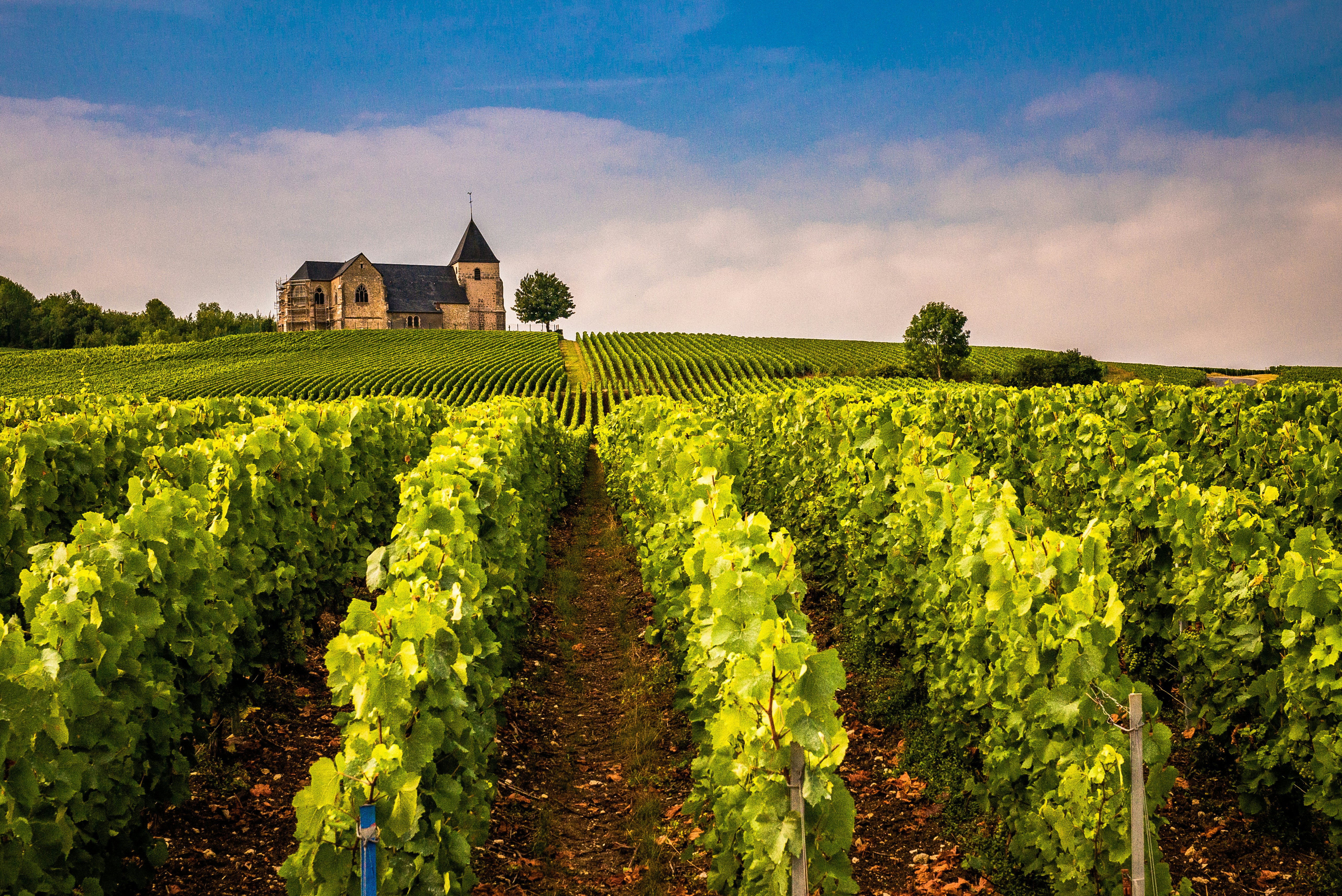
Champagne is the global reference point for fine sparkling wine, and the appellation that the traditional method is named for. The region sits about 150 km east of Paris, on chalk soils that are geologically continuous with the Kimmeridgian chalk band that runs under Chablis and resurfaces in the white cliffs of southern England.
The Champagne grape trio is Chardonnay (the structural white grape, gives length and minerality), Pinot Noir (the structural red, gives body and red-fruit weight), and Pinot Meunier (the workhorse red, gives early-drinking accessibility and softness). A blanc de blancs is made from Chardonnay only; a blanc de noirs is made from Pinot Noir and/or Pinot Meunier vinified without skin contact. Non-vintage Champagne (the standard tier) blends multiple years and all three grapes; vintage Champagne is made only in declared years and can be either a blend or a single varietal.
The dosage spectrum is the second axis. Brut nature (zero added sugar at disgorgement) is the driest. Extra brut, brut (the standard label), extra dry, sec, and demi-sec run progressively sweeter. Most prestige Champagne is brut or extra brut; demi-sec is reserved for dessert pairings and is rare in modern prestige.
The producer structure splits into Grandes Marques (the famous houses: Krug, Bollinger, Pol Roger, Roederer, Taittinger, Veuve Clicquot, Moët, Ruinart) and grower Champagne (small producers who grow their own grapes and make their own wine, often labelled récoltant-manipulant on the back of the bottle). The Grandes Marques produce most of the volume; grower Champagne produces most of the interesting wine at the prestige tier. Both are worth knowing. At the grower-Champagne peak, Roses de Jeanne (Cédric Bouchard's single-vineyard project in the Aube) is the cleanest entry into the category and one of the prestige producers in our index with a perfect-100 record, covered in The 100-Point Club.
Cava: Spain's traditional-method answer
Cava is the Spanish traditional-method category, produced primarily in Catalonia's Penedès region west of Barcelona. The classic Cava grape trio is indigenous: Macabeo (also called Viura in Rioja) for acid and citrus, Xarel·lo for body and the signature green-herbal note, and Parellada for floral aromatics. Some modern Cava also includes Chardonnay or Pinot Noir.
The price proposition is straightforward: Cava delivers traditional-method texture and complexity at a third to a half of the Champagne price. The trade-off is in style: Cava's indigenous grapes produce a wine with more green-herbal character and less of the toasty brioche complexity that long lees ageing gives Champagne. The wine is often drunk younger; the standard Cava is aged 9 months minimum on the lees, where Champagne is 15 months minimum (and prestige Champagne is often 5-10 years).
The top tier is Cava de Paraje Calificado, established in 2017, which requires single-vineyard sourcing and 36 months minimum on the lees. There are fewer than 20 producers at this level; the wines are genuinely competitive with vintage Champagne and priced accordingly. For value, the Reserva tier (15+ months on the lees) and the Gran Reserva tier (30+ months) are where Cava punches hardest against Champagne.
Crémant: France outside Champagne
Crémant is the umbrella term for traditional-method sparkling wine made in France outside the Champagne appellation. The major Crémants are Crémant d'Alsace (the largest by volume), Crémant de Bourgogne, Crémant de Loire, Crémant de Limoux (the oldest documented traditional-method sparkling wine in the world, predating Champagne by about 150 years), Crémant du Jura, and Crémant de Die. Each uses the grapes traditional to its parent region: Riesling and Pinot Blanc in Alsace, Chardonnay and Pinot Noir in Bourgogne and Loire, Mauzac in Limoux, Savagnin in Jura.
Crémant is often the smartest value play in serious sparkling. The traditional method is identical to Champagne's, the minimum lees ageing is 12 months (close to Champagne's 15), and the wines are sold at €15-30 retail, half the Champagne starting price. The trade-off is in fame: Crémant has no marketing budget. The wines are the equal of entry-level Champagne; the prestige isn't.
Prosecco: the approachable everyday bubble
Prosecco is the world's largest-volume sparkling wine category by some distance, and the canonical tank-method wine. The grape is Glera (renamed from "Prosecco" in 2009 to allow the appellation to protect the name); the heartland is the Veneto and Friuli regions of northeast Italy. The DOC/DOCG hierarchy runs from Prosecco DOC at the base (most of the volume, lighter style, drunk young), through Prosecco DOCG (the higher quality tier), to Conegliano Valdobbiadene DOCG at the peak, and within Conegliano Valdobbiadene, to the small Cartizze sub-appellation, which is the structural top of the Prosecco hierarchy.
The tank method preserves the primary stone-fruit and citrus character that Glera delivers: pear, green apple, white peach, almond blossom. The wine is meant to be drunk young, within a year or two of release; the long autolytic ageing that defines Champagne would actually destroy what makes Prosecco distinctive. The contrast with Champagne is structural: Champagne is built for ageing and reveals itself over time; Prosecco is built for freshness and reveals itself at the table. Both are correct answers to different questions.
Within Prosecco there is also a sweetness dimension that mirrors Champagne's: brut nature through extra dry (which is, confusingly, slightly sweeter than brut in Italian sparkling labelling) through dry (sweeter still) and demi-sec.
Franciacorta: the Italian traditional-method peak
If Prosecco is Italy's tank-method category, Franciacorta is Italy's traditional-method one. Produced in a small Lombardy zone east of Milan, Franciacorta uses Chardonnay (the dominant grape), Pinot Nero (Italian for Pinot Noir), and Pinot Bianco. The minimum lees ageing (18 months for non-vintage, 30 months for Millesimato (vintage), 60 months for Riserva) is the longest of any traditional-method appellation in the world, exceeding Champagne's minimums at every tier.
The "Italian Champagne" framing is approximately right but underplays Franciacorta's distinct character. The Lombardy climate is slightly warmer than Champagne's, the wines have slightly higher ripeness, and the Italian winemaking culture leans toward fresher, fruit-forward expression even at the prestige level. The result is a sparkling wine that drinks closer to a great vintage Champagne than to any other Italian style, with a slightly different aromatic profile: more peach and apricot, less brioche and lemon-peel.
English sparkling: the climbing newcomer
The story that the data tells loudest. English sparkling wine (produced in Sussex, Hampshire, Kent, and the broader chalk belt of southeast England) has gone from a curiosity in 2000 to a serious traditional-method category in 2025. The chalk soils are geologically continuous with the Champagne sub-stratum (the same Cretaceous formation). The grapes are the Champagne trio. The method is identical. And the climate, historically too cold to ripen Chardonnay or Pinot Noir reliably, has warmed enough over the last two decades that the southern English chalk belt now produces consistent prestige-tier sparkling wine.
The 2010s saw heavy capital investment: both Champagne houses (Taittinger, Pommery) and independent English producers (Nyetimber, Gusbourne, Hambledon, Chapel Down) planted vineyards specifically for sparkling production. The wines have a recognisable English character: slightly higher acid than Champagne, slightly leaner fruit, a chalky-mineral character that maps onto blanc de blancs Champagne specifically. The category is one of the clearer examples of the climate-convergence trend we covered in Regions on the Rise, a cool-climate region whose recent vintages now match what prestige critics historically rewarded only in warmer zones.
Lambrusco: the red sparkling outlier
The category that deserves a wider audience than it gets. Lambrusco is a family of red grape varieties from Emilia-Romagna, vinified into sparkling red wines that range from bone-dry to off-dry. The supermarket sweet Lambrusco of the 1970s and 1980s was a historical accident (a low-quality, mass-produced style aimed at the export market) and almost nothing to do with what serious Lambrusco actually is.
The grape sub-varieties matter. Lambrusco di Sorbara is the lightest and palest, almost rosé in colour, with high acid and red-cherry fruit. Lambrusco Salamino di Santa Croce is mid-weight, the most-produced sub-variety, drier than its reputation suggests. Lambrusco Grasparossa di Castelvetro is the darkest and most tannic, almost a serious red wine with bubbles. All three, in their dry expressions, are among the best food-pairing wines in the world, built specifically for the rich, fatty, salty Emilian cuisine (prosciutto, mortadella, Parmigiano-Reggiano, tortellini in brodo). The category sits awkwardly in international wine retail because it doesn't fit the white-fizz default, but for charcuterie, pizza, and fried food it has no real competitor.
How to choose
The decision tree, simplified:
- Special occasion, prestige bottle → vintage Champagne or Franciacorta Riserva
- Casual celebration, mid-price → Crémant (any region) or non-vintage Champagne
- Aperitif before dinner → Cava (entry-level) or Prosecco
- With food, generally → Cava Reserva, grower Champagne, or dry Lambrusco
- With charcuterie, pizza, fried foods → dry Lambrusco specifically
- With fish, oysters, sushi → blanc de blancs Champagne or English sparkling
- With Indian or assertively spiced food → off-dry Prosecco or Demi-Sec Champagne (the sugar is doing real work)
- For the wine geek who's had everything → grower Champagne from a known small producer, Crémant du Jura with Savagnin in the blend, or an artisan dry Lambrusco
Where to start
For everyday sparkling at the value end: a Cava Reserva (€10-15) or a Crémant d'Alsace (€15-20). Both deliver traditional-method texture for the price of a decent Prosecco.
For the casual celebration: a non-vintage Champagne from one of the Grandes Marques (€40-55), or a Franciacorta Brut from a known producer at the same price. Either reads as "proper sparkling" without crossing into vintage-Champagne territory.
For the serious occasion: a vintage Champagne from a top producer or a grower-Champagne blanc de blancs from Roses de Jeanne (€80-150). At this tier the wine rewards attention and ages: buy two, drink one now, age the other ten years.
For food-driven sparkling: a dry Lambrusco Sorbara at €15-20 will outperform almost any sparkling wine in its price range when matched with the right Emilian food. The category's low reputation is a buying opportunity.
For the cross-references where sparkling is the canonical pairing answer, see Wines That Pair With Fried Chicken and Wines That Pair With Goat Cheese. Both lean on the structural traits (high acid, low tannin, refreshing bubbles) that define this entire category.