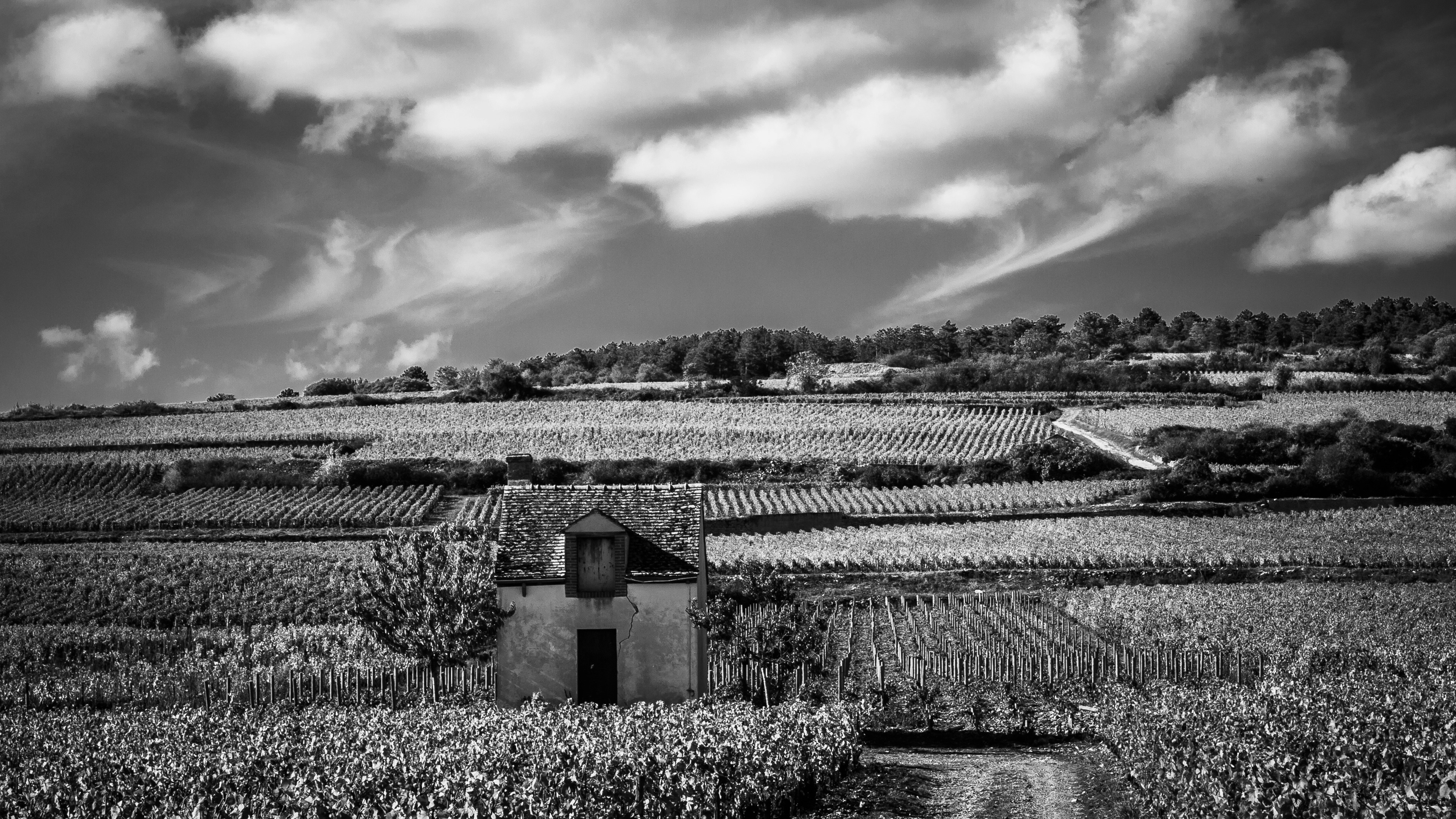
Cross the Rhine and Pinot Noir changes accent. In Burgundy it speaks the language of cru: Richebourg, Musigny, Chambertin, vineyards named like saints, hierarchies codified by Cistercian monks before the printing press. Two hundred kilometers east, in Baden, the same grape goes by Spätburgunder, and the language is different. Estates by name. Vineyards numbered, not canonized. And yet, on the prestige critics' scorecards, the gap is smaller than the geography suggests.
The shared thread
Both regions chase Pinot Noir for the same reason. The grape is thin-skinned, demanding, and merciless about climate: too cool and it greens, too warm and it loses its line. Burgundy and Baden sit on either side of that knife edge, in the same band of latitude, with growing seasons that flatter Pinot's love of cool nights. When the prestige critics (Wine Advocate, Decanter, Wine Spectator, Wine Enthusiast, Falstaff) go looking for Pinot Noir at the top of the 100-point scale, both regions deliver. Just not in the same number, and not in the same vocabulary.
Burgundy: the language of cru
Burgundy does Pinot Noir at scale: 4,248 estates in the Femente index dedicated to the grape, 34,400 indexed Pinot wines. Five hundred of those producers carry a FEM score of 90 or higher; twenty-nine sit above 95. The conversation runs through the Côte de Nuits, where the Grand Crus form an uninterrupted ribbon of limestone-rich vineyards south of Dijon: Chambertin, Musigny, Richebourg, Clos de la Roche. The cru hierarchy was effectively written in the eleventh and twelfth centuries by Benedictine and Cistercian monks who tracked which parcels delivered which character year after year, a thousand-year terroir experiment that the AOC system formalized in 1936.
The top of the pile is where the legend operates. Domaine Leroy's Musigny Grand Cru pulled a perfect 100 from Decanter, and the Richebourg matched it for both Decanter and Wine Spectator. Domaine Gros Frère et Soeur's Richebourg drew 100s from the same two critics. Maison Roche de Bellene's Chambertin Grand Cru hit 100 from Wine Advocate. The Grand Cru ribbon is, on the evidence, doing what the monks said it would.
The averages tell a different story. Across all of Burgundy's wines, Wine Spectator's average is 77 and Wine Advocate's is 79: generous if you came for the Grand Crus, sobering once you remember that 99% of the region's bottles never see one. Burgundy's signal is bimodal: a tiny apex of perfect scores, a long tail of village wines that are competent rather than transcendent.
Baden: the language of estate
Baden operates at a different scale. 601 estates make Pinot Noir here, against Burgundy's 4,248. The high-end gap is wider still: fifteen Baden producers clear FEM 90, none reach 95, and the region indexes 2,555 Spätburgunders against Burgundy's 34,400. Falstaff's average across the region is 91; Decanter's is 89. Baden tilts decisively to white wine (54% of production), but the Spätburgunder cohort, at roughly 28%, has built a reputation that travels.
The standard-bearer is Bernhard Huber in Malterdingen, where the Wildenstein Spätburgunder R drew 98 from Decanter and the Schlossberg version 97. Both single-vineyard wines, both Pinot, both showing what a German producer can do when the vineyard is treated as the unit of expression rather than a footnote to the village. Enderle & Moll, working in Münchweier, holds 98 from Wine Advocate for their straight-named Pinot Noir: natural winemaking, no oak interference, the grape allowed to speak. Weingut Hermann sits at 98 from Wine Advocate, 95 from Wine Enthusiast, and 94 from Wine Spectator for their Pinot Noir***, uniform consensus across critics, which in this scoring format is itself a kind of stamp.
What Baden lacks is Burgundy's classification scaffolding. There is no Grand Cru tier, no thousand-year cru cadastre. The VDP's GG (Grosses Gewächs) designation is the closest equivalent, a single-vineyard top tier, but it operates on producer self-organization rather than legal AOC. The top wines are made; they are not pre-validated by the system. This is freedom, but it is also the burden the German producer carries: every bottle has to argue itself.
Where they diverge
The divergence is not in the grape. It's in what the system promises before you open the bottle. A Burgundy Grand Cru tells you, by name alone, that you are at the top of a thousand-year hierarchy. A Baden Spätburgunder tells you the producer's name and the vineyard, and asks you to know what those mean. One is a cathedral with marked altars. The other is a workshop where you have to learn the maker's hand.
The character signal moves with the geography too. Across the 2,555 Baden Spätburgunders in the index, the strongest tasting descriptors are cherry, strawberry, and raspberry (bright red fruit) followed by oak, earth, and a band of smoke and cranberry that the Baden cohort owns more than any other Pinot region we track. Burgundy, mining 34,400 Pinot wines, lands on the same red-fruit triad and shares the oak and earth, but its sixth-strongest descriptor is mushroom, the savoury, forest-floor note that Burgundian Pinot Noir is famous for and that Baden, on the data, does not develop in the same way.
The economics follow. Leroy's Musigny is not a wine you stumble into. The Wine Advocate average for Baden (81) is higher than Burgundy's (79), which is what happens when a region's scoring sample is dominated by serious producers rather than diluted by the long village tail. Per dollar of bottle, the German Pinot is, on the data, a more efficient delivery mechanism for critic-validated character, even if the ceiling is lower.
Where to start
Two entry points. From Burgundy, Louis Jadot's Clos de la Roche Grand Cru, a négociant making a Grand Cru, which historically was the affordable doorway into the legend (98 from Wine Enthusiast, less of a wallet event than Leroy). From Baden, anything from Bernhard Huber: Wildenstein if you can find it, Schlossberg if you cannot. Same grape. Different accent. Drink them in that order if you want to hear it.