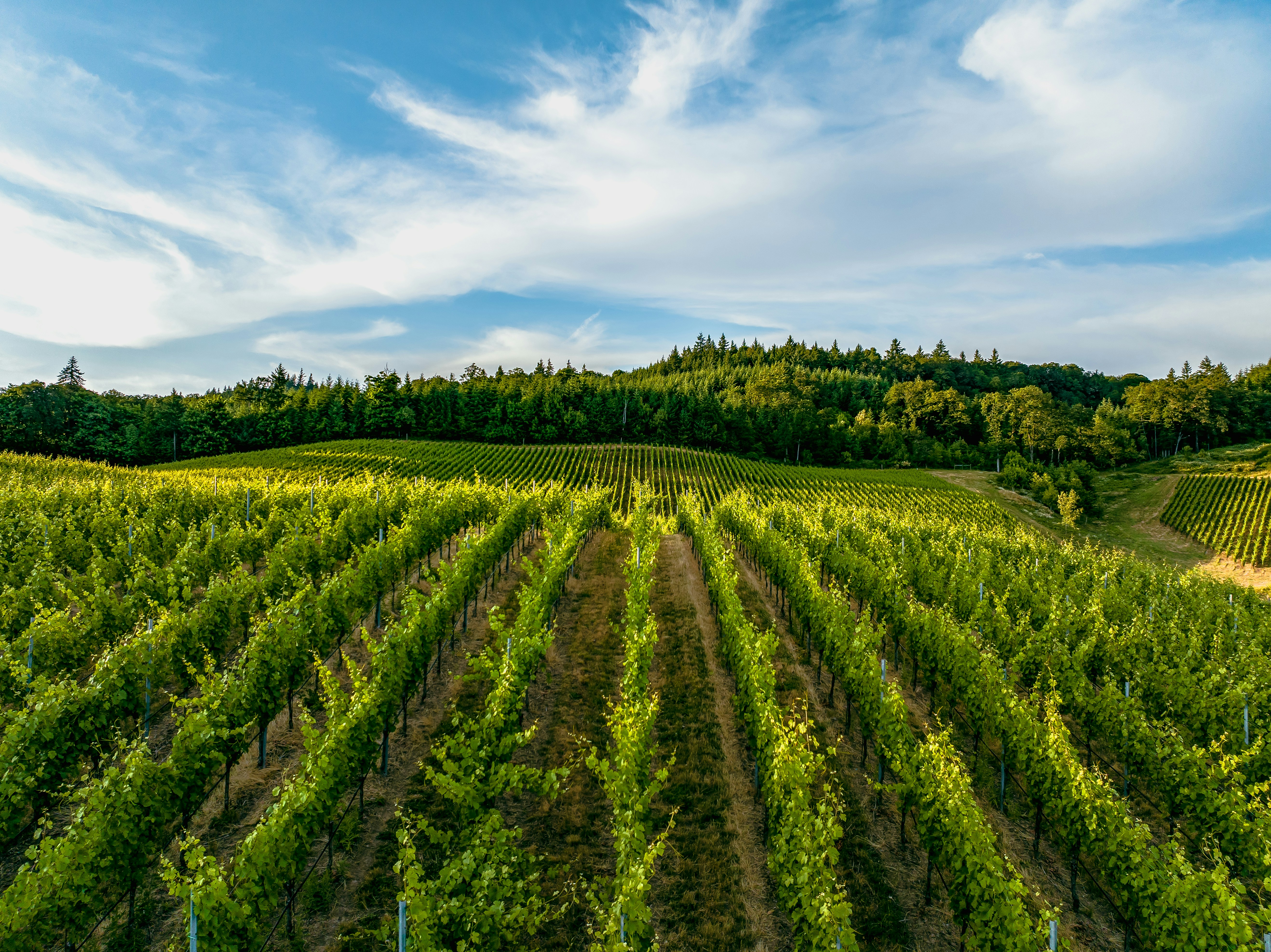
Pinot Noir is the grape that does not transplant well. It refuses warm climates, it falls apart under oak abuse, and it is one of the few red varieties whose tasting profile changes more than its name does as it crosses borders. We have already walked the European version of this story: Burgundy and Baden, the same grape on either side of the Rhine. The third accent is across the Atlantic. The Willamette Valley in Oregon plants the same Pinot, on the same band of latitude as Burgundy, but in a winemaking culture that grew up in the late twentieth century rather than the eleventh. Three regions, one grape, three different conversations.
The shared thread
Pinot Noir is the grape that exposes its terroir. It is thin-skinned, light in pigment, low in tannin, and sensitive to almost every winemaking decision. There is no blending out a problem, no disguising the vineyard with extra extraction. This is why Pinot is the grape on which serious wine-growing regions stake their reputation: Burgundy in the eleventh century, Baden in the twentieth, the Willamette in the 1970s. All three regions sit in the same narrow band of latitude (between 44° and 49° N), all three have growing seasons that flatter Pinot's love of cool nights, and all three measure themselves on the prestige critics' 100-point scale.
Burgundy: the language of cru
Burgundy does Pinot Noir at scale: 4,248 estates dedicated to the grape, 34,400 indexed Pinot wines, 500 producers carrying FEM 90 or higher, twenty-nine sitting above 95. The conversation runs through the Côte de Nuits, where the Cistercian monks codified a thousand-year cru hierarchy and the AOC system formalized it in 1936.
The cru tells the story before the producer does. Domaine Leroy's Musigny Grand Cru pulled 100 from Decanter; the Richebourg matched it for both Decanter and Wine Spectator. Maison Roche de Bellene's Chambertin Grand Cru hit 100 from Wine Advocate. The vineyard name carries the wine into the room.
The tasting signature, across 34,400 indexed Pinots, runs Cherry, Raspberry, Strawberry, Oak, Earthy, Red fruit, Leather, Mushroom, Vanilla. Burgundy is the only one of the three regions where mushroom enters the top descriptors, the savoury, forest-floor note that emerges from older oak and longer aging. The wine smells like its own cellar.
Baden: the language of estate
Baden, 200 km east across the Rhine, plants Pinot Noir under the German name Spätburgunder. The scale is smaller (601 producers, 2,555 indexed Spätburgunders) and there is no cru hierarchy to lean on. Fifteen estates carry FEM 90 or higher. None reach 95.
The producer is the unit. Bernhard Huber in Malterdingen carries the region: Wildenstein Spätburgunder R drew 98 from Decanter, the Schlossberg version 97. Enderle & Moll in Münchweier holds 98 from Wine Advocate for the straight-named Pinot Noir, made with no oak interference. The vineyard name is on the bottle, but you have to know what it means; there is no Grand Cru shorthand to do the work for you.
The tasting signature reads Cherry, Strawberry, Raspberry, Oak, Earthy, Red fruit, Smoke, Cranberry, Vanilla, Leather. Smoke and cranberry sit in positions seven and eight, descriptors that the Burgundy index does not have in its top ten. This is what cool slate-and-volcanic Pinot does that limestone Pinot does not.
Willamette: the language of vintage
Willamette Valley in Oregon planted its first Pinot Noir in 1965, when David Lett of Eyrie Vineyards bet that latitude 45° N (Burgundy's latitude) would work on the western edge of America. It worked. Today the index counts 660 estates producing Pinot, 2,930 indexed wines, and 155 producers above FEM 90, nine of them above 95.
The top picks come from a generation of producers who grew up making Pinot Noir as their first decision, not their inherited one. Patricia Green Cellars' Estate Vineyard Wadensvil Block Pinot Noir pulled a perfect 100 from Wine Enthusiast. Bethel Heights, in the Eola-Amity Hills, holds 99 from Wine Advocate for the Casteel Pinot Noir. Martin Woods takes 99 from Decanter for the Hyland Vineyard. Cristom sits at 95 from Falstaff for the Marjorie Vineyard.
The tasting signature: Cherry, Earthy, Raspberry, Strawberry, Oak, Red fruit, Vanilla, Cranberry, Leather, Smoke. Vanilla in position seven is the giveaway: the Willamette uses more new American or French oak than the average Burgundy producer, which lifts vanilla and softens the wine into a fruitier, slightly riper register. Cranberry, also in the top ten, sits exactly where it does in Baden, the cool-climate signal that crosses oceans.
Three accents in summary
The data tells a clean three-way story. Burgundy has the highest top-end concentration: twenty-nine estates above FEM 95, more than three times the Willamette and Baden combined. The Willamette is the modern second tier: nine estates above 95, a flagship Pinot Noir region built in two generations rather than ten. Baden is the smallest of the three at the top end (zero above 95) but indexes the highest critic average across its full sample, because the Baden index is dominated by serious producers rather than diluted by a long village tail.
The character signal is what separates them most sharply. Burgundy reaches for mushroom, the descriptor that Pinot only develops with bottle age and traditional cellar work. The Willamette reaches for vanilla, the new-oak signal of a younger winemaking culture. Baden reaches for smoke and cranberry, the cool-climate notes of a region that grows Pinot at the temperature edge. Same grape. Three different sentences about what it can become.
Where to start
Three entry points, one per region. From Burgundy, Maison Roche de Bellene's Chambertin Grand Cru, 100 from Wine Advocate, the cru-system canonical statement. From Baden, Bernhard Huber's Wildenstein Spätburgunder R, 98 from Decanter, single-vineyard, the German producer-driven statement. From the Willamette, Patricia Green Cellars' Estate Vineyard Wadensvil Block, 100 from Wine Enthusiast, the New World vineyard-driven statement.
Drink them in that order. The grape will not change. The accent will.