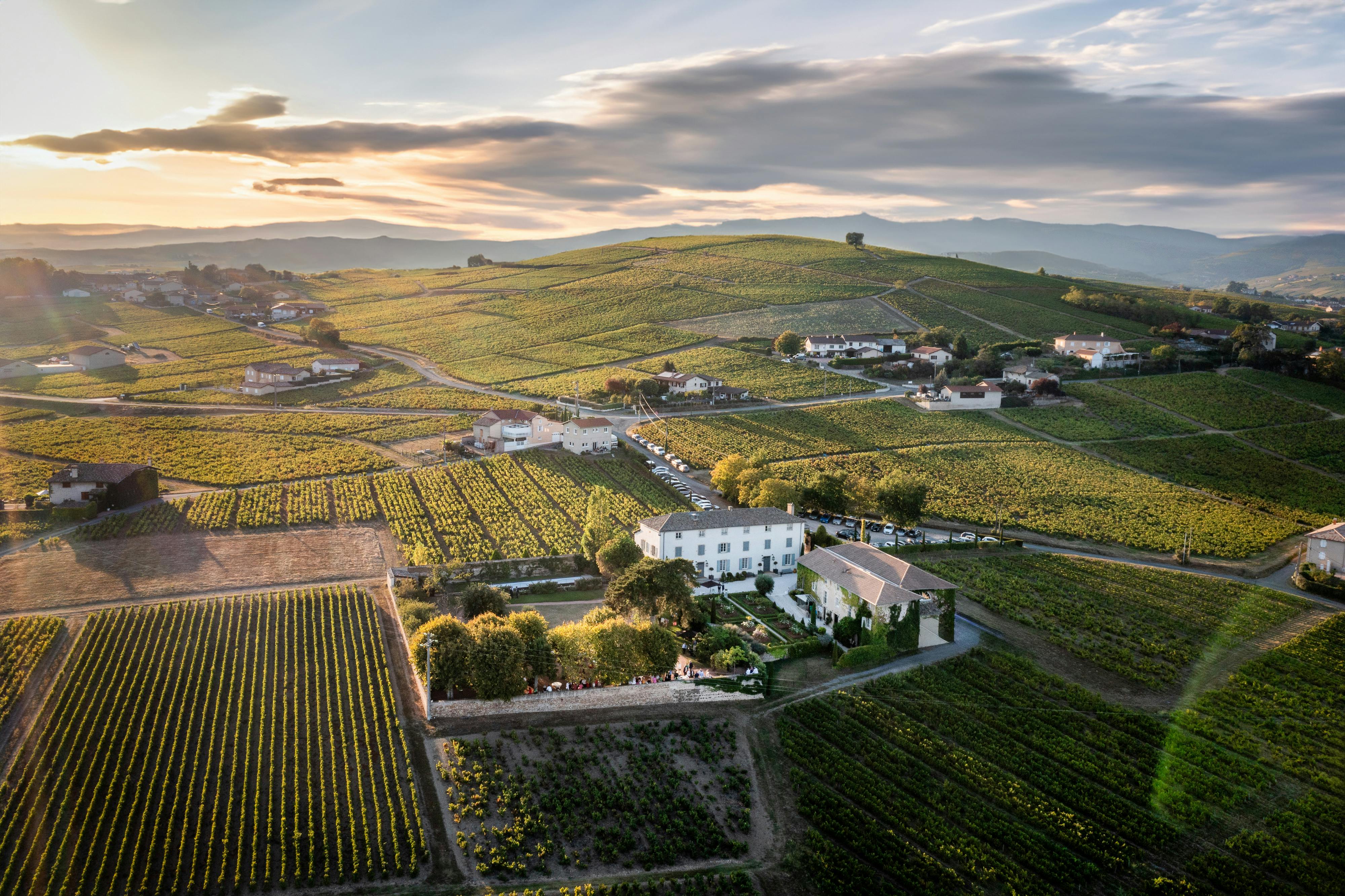
Open a cheap Beaujolais Nouveau in November and the first thing your nose finds is banana. Not red fruit, not earth, not the Gamay you were hoping for — banana, often with a coat of pear-drop candy behind it. The instinct is to think the wine is faulty or sweetened. Both are wrong. The banana is the chemical signature of the technique that defines the entire region.
The smell comes from a single molecule called isoamyl acetate, an ester that forms when certain yeasts ferment grape juice in a low-oxygen environment. Carbonic maceration produces exactly that environment: whole bunches of Gamay are loaded into a sealed tank under carbon dioxide, and fermentation begins inside the intact berries rather than in a pulpy slurry of crushed fruit. The intracellular reaction throws off isoamyl acetate the way a more conventional red fermentation throws off colour.
Beaujolais
None of this was an accident. Carbonic maceration was first made systematically by Michel Flanzy in 1934 and commercialised by Jules Chauvet in 1951 — the same Beaujolais chemist whose later students went on to build the natural-wine movement. The technique gives Gamay its low-tannin, lifted-strawberry profile and its very short ageing curve. The downstream effect is also why Beaujolais Nouveau is shipped six weeks after harvest and meant to be drunk young rather than cellared.
Two cues separate technique from fault. First, the banana note is most pronounced in the youngest, most industrial bottlings and fades within a year. Second, the serious wines of the region — the cru bottlings from Morgon, Moulin-à-Vent, Fleurie and the other named villages — use much shorter carbonic phases or skip the technique entirely, which is why their fruit reads as cherry and raspberry rather than banana. The catalogue confirms it: the dominant primary tasting keywords across our Beaujolais inventory are strawberry, cherry and raspberry, with banana surfacing only in the entry-level wines.