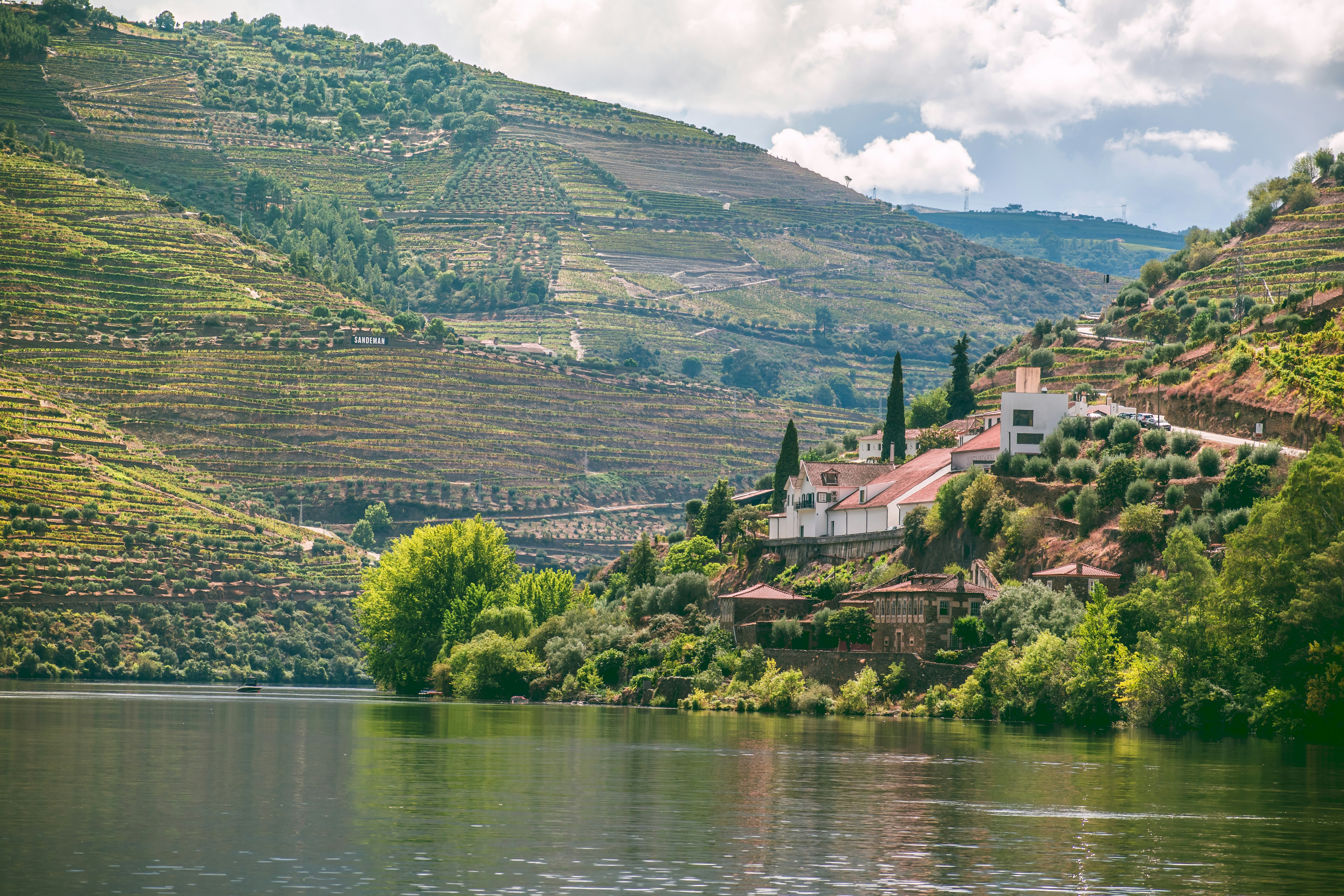
The Douro Valley is one of the most photographed wine regions in the world: terraced slate vineyards on slopes so steep they had to be hand-cut over centuries, the Douro River winding through the canyon, hilltop quintas (estate farmhouses) whose foundations predate the modern Portuguese state. The geography is also why the region's wines are what they are: extreme slate soils, baking summers, the river-canyon climate. Most travelers tour the Douro as a 1-2 day extension from Porto. Here's how to do it, with the actual prestige-tier producers worth visiting.
The geography you need to know
Porto is the historic Port-shipping city at the mouth of the Douro River, on the Atlantic coast. The Port houses (Sandeman, Taylor's, Graham's, Niepoort, Croft) historically aged their wines in cellars across the river in Vila Nova de Gaia, which is why Port is associated with Porto in the cultural imagination even though no Port grapes are grown there.
The actual Douro vineyard region, the Douro DOC, runs east from Régua, about 100 km upriver from Porto. The most prestigious sub-zones are:
- Cima Corgo: the heart of the region, around the village of Pinhão. Most of the great quintas are here. The most-photographed Douro landscapes (terraced slate, hairpin curves) are this stretch of river.
- Douro Superior: the easternmost part, near the Spanish border. Drier, more extreme. Some of the most ambitious dry-Douro reds come from here.
- Baixo Corgo: the westernmost sub-zone, closer to Régua. The cooler, wetter end of the appellation; historically lower-status, increasingly serious for dry whites.
For a day trip from Porto, Pinhão is the realistic destination. For two days, you can stretch to Douro Superior. Régua is the closest serious wine town if you're cutting the trip short.
What to drink (the prestige tier)
Vintage Port: three perfect 100s
Quinta do Vale Meão: Vintage Port scored 100 from Wine Advocate. Sits in the Douro Superior at the eastern end of the region; the producer is one of the originators of single-quinta Vintage Port, breaking from the historical practice of multi-vineyard blends.
Quinta do Vesuvio: Vintage Port scored 100 from Wine Advocate. One of the largest individual vineyards in the Douro, also in Douro Superior. The Vintage Port is declared only in exceptional years.
Quinta do Crasto: Vintage Port scored 100 from Wine Advocate. Crasto is in the Cima Corgo near Pinhão and is one of the producers most actively bridging classical Vintage Port with modern dry Douro red.
Tawny / Colheita Port
Niepoort: Colheita Port (vintage-dated Tawny) scored 100 from Falstaff. We profiled Niepoort in our Five Critics piece. Falstaff's perfect-100 Niepoort Colheita is the producer's signature work in long-aged Tawny.
Dry Douro (still red wine)
Wine & Soul: Pintas Tinto scored 98 from Wine Spectator. The Pintas range is one of the most internationally-rated dry Douro reds in our index. A small producer with cult-tier prices.
Quinta da Boavista: Vinha do Ujo Vinhas Velhas scored 96 from Wine Advocate. Old-vine field-blend dry Douro from one of the more historically-rooted producers.
Quinta do Fojo: straight Douro red scored 94 from Wine Spectator. A smaller estate, focused on single-varietal Touriga Nacional and old-vine field blends.
Practical logistics
Train from Porto to Pinhão: ~2.5 hours through the river canyon. The train follows the river bank for most of the route. The journey is a sightseeing trip in itself. Departures from Porto-São Bento. This is genuinely one of the most scenic train rides in Europe.
Driving from Porto: 1.5-2 hours by car along the A4 motorway, then the EN222 from Régua to Pinhão (the EN222 is regularly named one of the world's most scenic drives). Self-driving is more flexible than the train but requires a designated non-tasting driver.
River cruises: most Porto-based "Douro Valley wine tour" packages include a boat segment of the river: typically a 1- or 2-hour cruise from Régua or Pinhão. Worth doing once for the perspective; the river is the original reason for the terraces.
Quinta visits: the prestige producers above are mostly visit-by-appointment. Many smaller quintas offer walk-in tasting + tour packages, often paired with lunch overlooking the river. The visit-and-lunch combination at a working quinta is the canonical Douro day-trip experience.
Best time of year: late April through early June (everything is green and in flower), and mid-September through October (the harvest is happening). July and August are hot (the canyon traps heat) and some producers slow tours during the heat. The post-harvest period in October is the working-cellar season.
Where to start
Three Douro tour formulas.
For the Porto day trip: train to Pinhão, lunch at a working quinta, river cruise, evening train back. Most of the prestige Vintage Port producers are bookable for half-day visits.
For the overnight: Pinhão-based hotel, two days of quinta visits split between Cima Corgo classics (Quinta do Crasto, Wine & Soul) and a Douro Superior day trip out to Quinta do Vale Meão or Quinta do Vesuvio.
For the deep cut: a 3-4 day Douro extension with stops in all three sub-zones, ending at one of the cellars in Vila Nova de Gaia (Niepoort's Port lodge is one of the more thoughtful tours) for the urban Port-house side of the story.