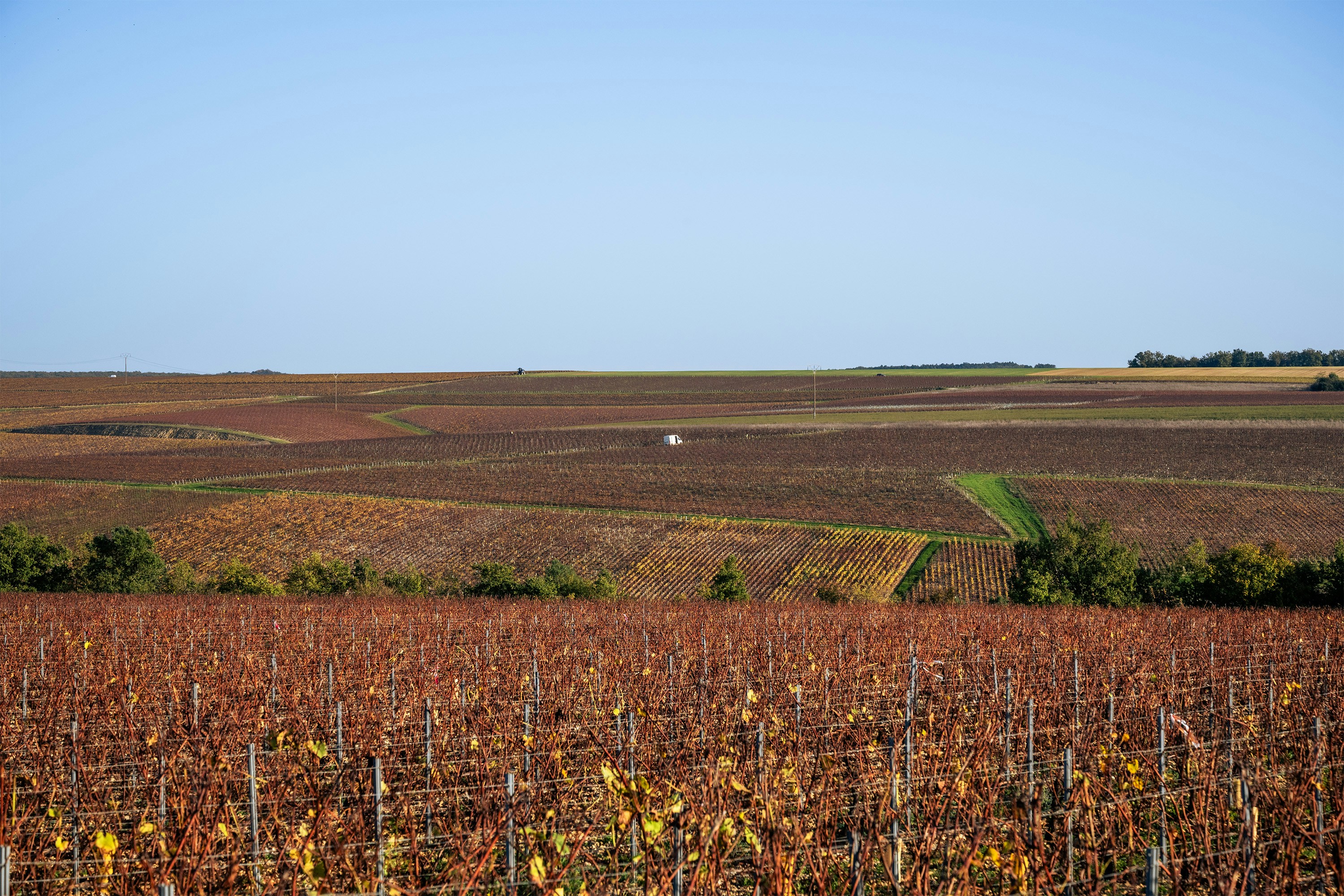
Both regions are inside Burgundy. Both grow Chardonnay almost exclusively. Both have a Grand Cru tier and a thousand-year history of telling you exactly which vineyard your wine came from. And yet the Chablis Chardonnay and the Côte de Beaune Chardonnay do not taste like neighbors. They taste like a single grape arguing with itself about whether the soil or the cellar should win.
The shared thread
Chardonnay is the most ductile of the great white grapes. Plant it almost anywhere with a long enough cool season and it will give you something. Treat it differently in the winery and it will hand back a different wine: stainless steel keeps it linear and citric; new oak rounds it into vanilla and cream. The grape is neutral enough that the winemaker's choices show up almost unfiltered. Burgundy is the textbook on this. The same grape, planted on the same band of limestone-derived soils, is fermented two completely different ways depending on which end of the region you stand at.
Chablis: the language of soil
Chablis sits 110 kilometers north of the Côte de Beaune, almost in Champagne. The latitude is harsher; the soils are Kimmeridgian: a Jurassic limestone shot through with fossilized oyster shells, the same calcaire-and-clay base that runs under the Loire and surfaces again in southern England. The orthodox Chablis approach is to ferment and age in stainless steel or neutral oak: keep the wine clean, let the soil speak, refuse the butter.
The data confirms the orthodoxy. Across the 2,696 Chablis Chardonnays in the Femente index, the leading tasting descriptors are Citrus, Minerals, Lemon, Green apple, Apple, and Pear. Stone sits at #10, a descriptor that does not appear in the Côte de Beaune's top ten at all.
The standard-bearer is Vincent Dauvissat for the Chablis 1er Cru 'Montée de Tonnerre' (98 from Decanter), a single-vineyard Premier Cru aged in old, neutral barrels, the canonical case for Chablis without makeup. Domaine Laroche takes 99 from Wine Spectator for the Grand Cru 'Les Clos', the most prestigious site in the appellation. Domaine des Malandes matches Laroche with 98 from Wine Advocate on the same vineyard. The Femente index counts 456 estates making Chardonnay across Chablis, 43 of them at FEM 90 or higher, three above 95.
Côte de Beaune: the language of cellar
Côte de Beaune is Chablis's wealthier southern sibling. 695 producers make Chardonnay here, 5,032 indexed wines, 171 estates above FEM 90, four above 95. The Grand Cru roster is operatic: Montrachet, Chevalier-Montrachet, Bâtard-Montrachet, Bienvenues-Bâtard-Montrachet, Corton-Charlemagne, vineyards whose names sell wines at thousands per bottle and have done so for two centuries.
The orthodox Côte de Beaune approach is the opposite of Chablis: barrel fermentation, often in new or near-new French oak, extended lees aging, malolactic conversion that softens the acidity into cream. Across 5,032 indexed Chardonnays, the leading tasting descriptors are Butter, Oak, Citrus, Minerals, Lemon, Vanilla, Apple, and Cream. The first two are the cellar showing through the grape.
Domaine Coche-Dury is the canonical name. Its Corton-Charlemagne Grand Cru pulled 100 from Decanter and 100 from Wine Advocate. Domaine des Comtes Lafon's Montrachet Grand Cru takes 100 from Wine Spectator. Philippe Colin's Chevalier-Montrachet draws 98 from Wine Enthusiast. Domaine Henri Boillot's Puligny-Montrachet 1er Cru Les Pucelles holds 94 from Falstaff, a producer who works the line between Chablis-style restraint and full Côte de Beaune barrel-driven richness.
Where they diverge
The contrast is unusually clean for a wine comparison: same grape, same family of limestone soils, same country, same region's classification system, and yet the two appellations have organized themselves around opposing answers to the same question. Chablis treats the cellar as a clean room; the Côte de Beaune treats it as a workshop. Chablis says the wine should not have to argue with the wood; the Côte de Beaune says the wood is part of the wine.
The price of admission follows the philosophy. The Côte de Beaune indexes 5,032 Chardonnays against Chablis's 2,696 (almost two-to-one) and the Grand Cru ladder is steeper. Per-bottle, Chablis Grand Cru sells for a fraction of Montrachet, and Chablis Premier Cru is one of the few entry points in Burgundy where a serious wine still costs serious-but-not-absurd money. The trade is honest: you get less of the cellar, more of the soil.
Where to start
Two entry points. From Chablis, Vincent Dauvissat's Premier Cru 'Montée de Tonnerre' (98 Decanter), the classical statement of unoaked Chablis from a single vineyard, no concessions, soil-first. From the Côte de Beaune, Domaine Henri Boillot's Puligny-Montrachet 1er Cru Les Pucelles (94 Falstaff), barrel-fermented, lees-aged, the controlled luxury end of the spectrum without the Grand Cru wallet event. Drink the Chablis first to hear what the limestone says when nothing else is allowed in. Drink the Boillot second to hear what the same grape sounds like when the cellar joins the conversation.